Do It Your Way
It’s hard to find the “perfect” anything In life. We found two in Italy: the perfect gelato in Rome and the perfect sandwich in Florence. It’s possible that we also found the perfect cannoli.
I didn’t bury the lede on Italy, but besides being filled to the brim with culinary delights, Italy is full of beautiful landscape, magnificent works of art and architecture, and amazing history.
My husband and I completed a DIY trip to Italy in October of 2025. Beforehand we did a lot of research: what to avoid, what to do, how to pack, and what to eat. I even watched a YouTube video on how to order coffee, you know, the important things.
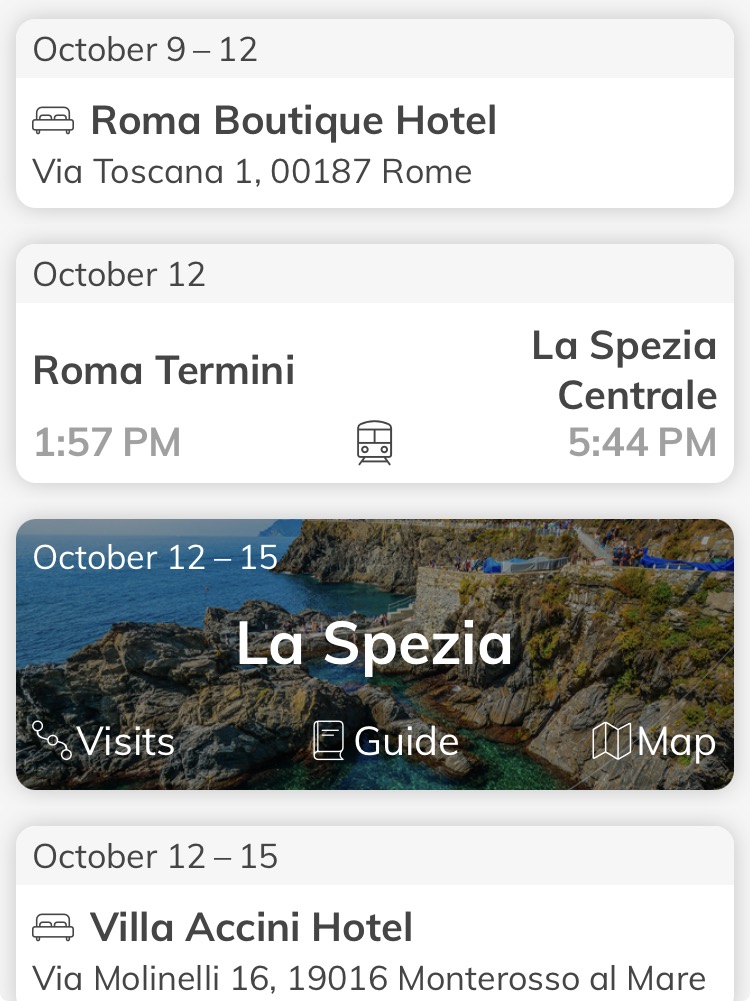
We booked this trip on Tripmasters.com, based on a recommendation by our daughter. It’s a travel website that is easily customized and provides an app that makes all your bookings available at your fingertips. It helped make this trip of a lifetime such a success. What follows is a treasury of our great adventure and perhaps an inspiration to anyone planning to go to Italy.
A friend said, “Go to as many places you can in Europe before you go to Italy because once you go there, you won’t want to go anywhere else.” That’s an obvious overstatement but the point is taken: Italy is a gem and plan to enjoy it.
We struck such a good balance with our Italy agenda going to Rome first, then the relaxed vibe of Cinque Terre, and finishing with Florence. We spent three nights at each place.
The places we visited have stunning views, ancient wonders, Renaissance beauty, and the food ain’t bad either. In fact, the food is what I miss most. It’s real, and simple, and delicious. My grandma cooked the southern Italian cuisine, the peasant-style comfort food. We visited the middle sections of Italy: Cinque Terre, the birthplace of focaccia; Tuscany, known for its beef; and Rome, a melting pot of cultural influences. In other words, we didn’t find any meatballs or traditional Calabrese gravy/sauces with spaghetti, or pepperoni pizza. But we got focaccia, pesto, beef stews, and pasta dishes like cacio e pepe that were incredible.
Day 1 – It’s easy for an English speaker to get around. Signage in transportation centers often provides the English and other languages common to travelers. When we landed in Rome and got our luggage, we easily found the signs for the Leonardo Express train to Rome Termini. There were kiosks and people to help purchase tickets.
In Rome, we turned on Apple Maps and began our journey into the harrowing and exciting world of Rome’s byways.
Rome transported us seven hours ahead so 3 a.m. was now 10 a.m., you’ve been awake for 20 hours (minus a few minutes of the gap-mouth airplane slumber), and you better get your butt a’ moving because Rome don’t appreciate your hesitation.
The traffic in Rome is hard to describe. It’s not orderly or reasonable. There aren’t bike lanes, commuter lanes, or special lanes for buses. Everything with wheels owns and partakes of a piece of the road. You might be walking down a street that you’d consider an alley in the U.S. and suddenly a car approaches, then a scooter, and then a shuttle bus. You mosey out of the way. Or you might be strolling through a piazza filled with pedestrians and you hear a little beep. Yes, it’s a car; even though it’s cobblestone and there are no lines or speed limit signs. That said, Italians seem to be used to it because I heard little angry beeping or signs of road rage.
We planned day one to be our easiest because it also was a travel day, sort of. We rested an hour then set off to discover why we came to Rome. We walked to San Pietro’s Piazza Basilica, otherwise known as St. Peter’s Square in the small enclave called Vatican City. It wasn’t our intent to visit the Vatican or Sistine Chapel. However, we wanted to visit St. Peter’s Basilica which took 120 years to build and rumored to be breathtaking. It had been unexpectedly closed in the morning and by the time we got there at 3, the line was too long. We walked around the square taking in the sights, mostly nuns and many in religious orders lining up for small processions. We heard many different languages of prayers in these processions.
Vatican City is so close to the Tiber River (Tevere in Italian) and there are lovely bridges and neighborhoods nearby. Once again, my husband’s Packers hat touched off some conversations, most memorable from a couple from Liverpool who thought the G was for Georgia. We explained the Packers G came first and other inconsequential facts about the Bulldogs.
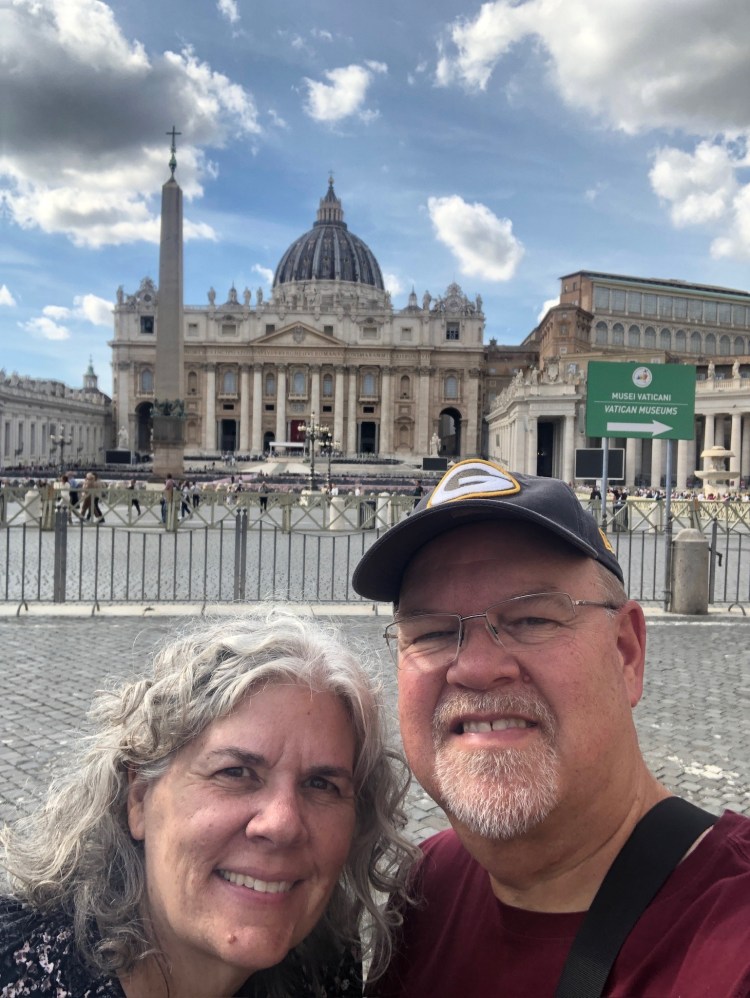
We wandered the city center taking in Rome, walking past the Pantheon and Campo dei Fiori. Getting back to our accommodations, Roma Boutique Hotel, near the Borghese Gardens area of Rome, we asked the concierge a recommendation for dinner. She suggested San Marco’s Pizzeria which was only several blocks away.
We researched how to eat a meal in Rome and Italy in general: you do not tip your waiters; however, you will pay for your water (naturale or fizzamente) and you will get a table charge that runs between 2 to 3 Euros per person. At San Marcos’ we sat on the covered porch and enjoyed carbonara and Bolognese and a shared salad (balsamic vinegar, EVOO, and salt and pepper were delivered to the table to dress the salad).
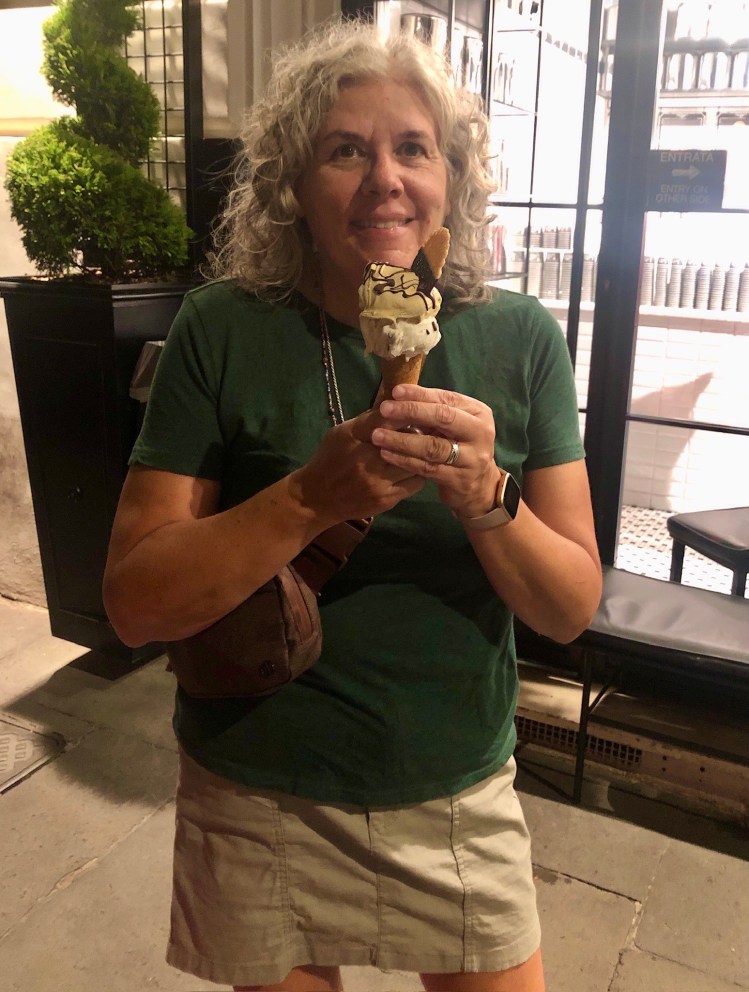
We saved room for dessert and searched for gelato, because Italy, and found in walking distance the best gelato we ever had at Come il Latte Gelateria (translated as Just Like Milk). This place was a gem, seemingly delivered there by divine intervention. In our pre-Italy research, we learned the best gelato is not found in heaping trays of brightly colored product. That is probably okay but not traditional and not as good. We packed food snobbery (we don’t leave home without it) on this trip and certainly intended to use it. Come il Latte gelato was properly stored in covered stainless steel bins and avoided artificial bright food colors. What it did provide was a cone, layered inside with your choice of milk or white chocolate; delicious, creamy gelato; and a wafer dipped in milk or white chocolate placed on top. In addition, whipped cream was offered on top. It was a great way to end our first day in Italy.
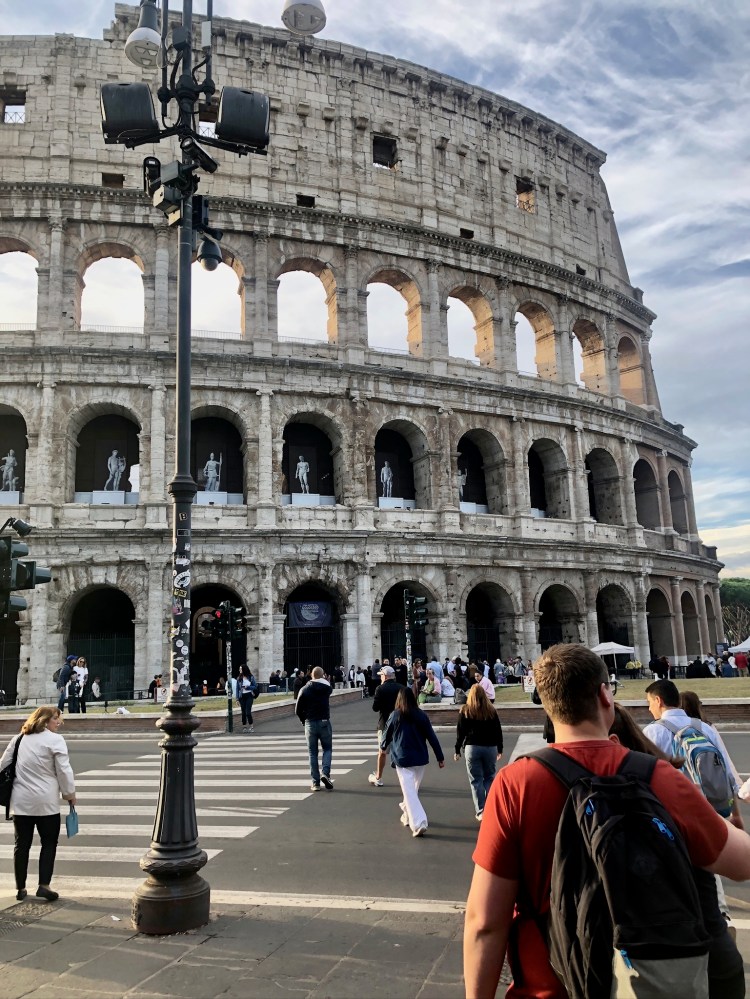
Day 2 – We began our first full day with pre-booked tours: Colosseum, Roman Forum, Palatine Hill; and an evening street food tour. Both of these were booked at home on Get Your Guide. Since our hotel was quite far from the Colosseum, we took a short walk (half a mile) to the Metro stop near the Spanish Steps. The subway stations and trains are clean and safe. Ascending from the “Colosseo” stop brought us face-to-face with the Colosseum. Breathtaking.
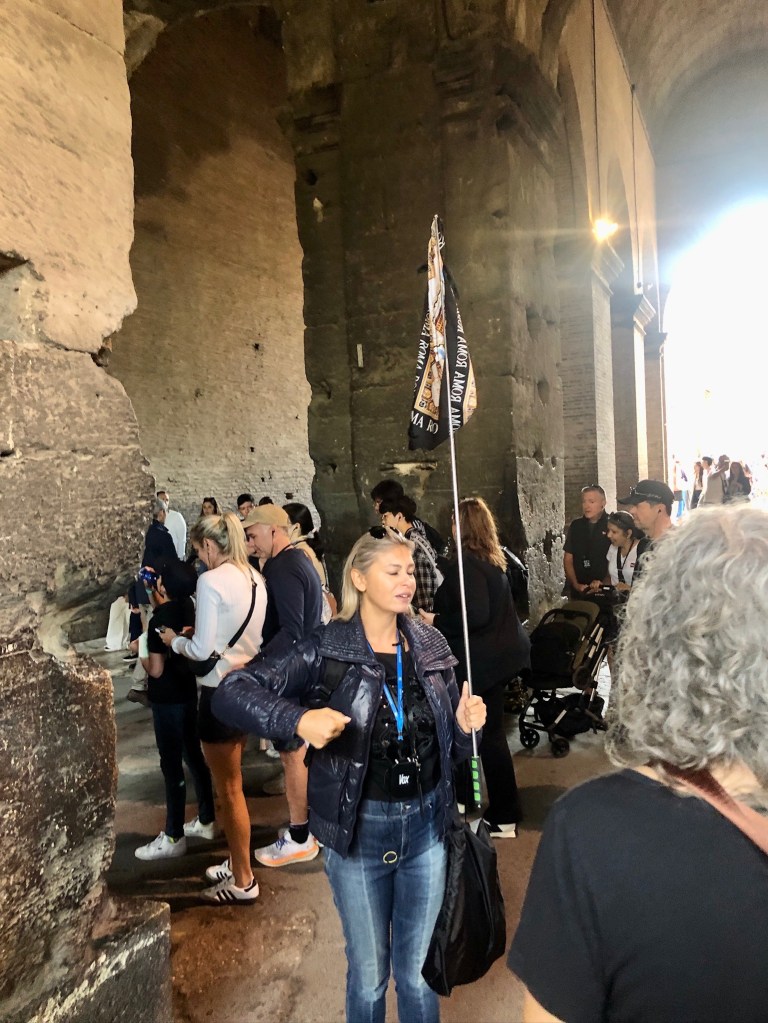
We walked to our meeting point, got our earbuds and radio receiver, met our guide, and began our journey. You’ve seen groups like ours around tourist spots: trudging along following a talking guide who is holding up some catchy icon or flag so we can find him/her in a crowd. While taking on the vacant look of a college lecture pit, we were hanging on every word.
The Colosseum was fascinating, ancient and ( full of stories of which we barely scratched the surface. In its heyday, it was a mecca of entertainment for all Rome: four levels of seating for ruling class, upper class, average joes(giuseppes?), and slaves. The place was built by slaves and many of the gladiators were slaves. When the Roman Empire sacked Jerusalem in 70 AD and kicked off the Jewish diaspora, they plundered all the jewels, gold, and treasure from Solomon’s Temple (what remains is the Wailing Wall). They also took many of the citizen, some to sell and some to build the Colosseum. That bootie was sold to fund the project. In the nearby Arch of Titus, the plundering of Jerusalem is portrayed in carvings, and that arch was the model for the Arc de Triomphe in Paris.
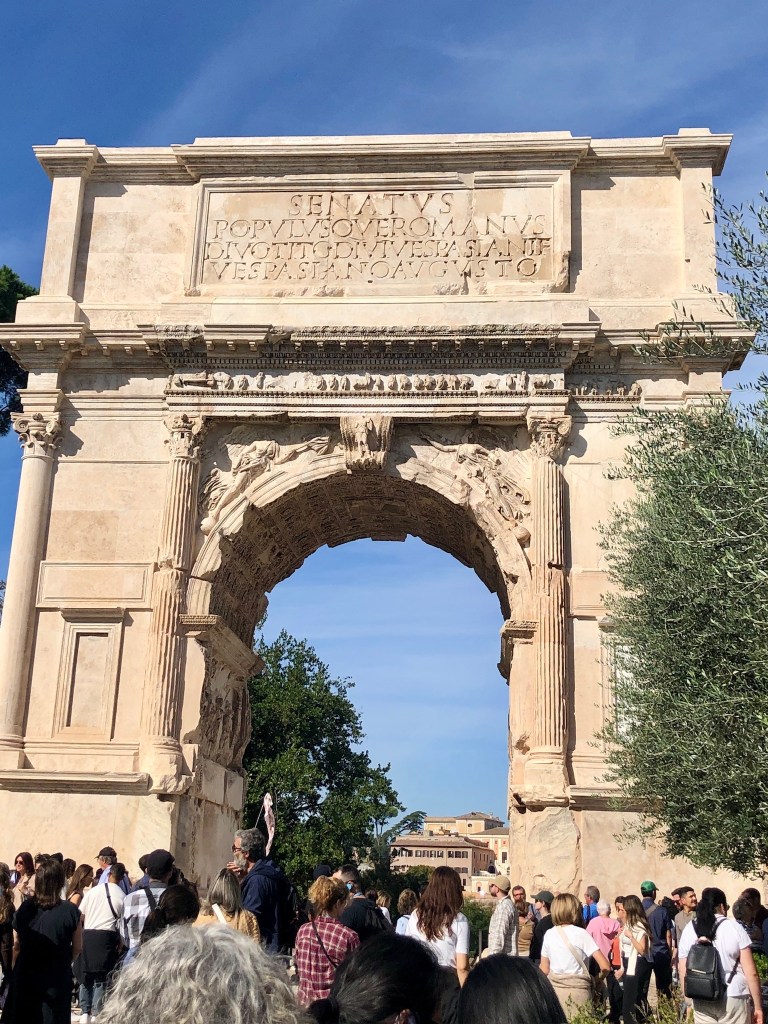
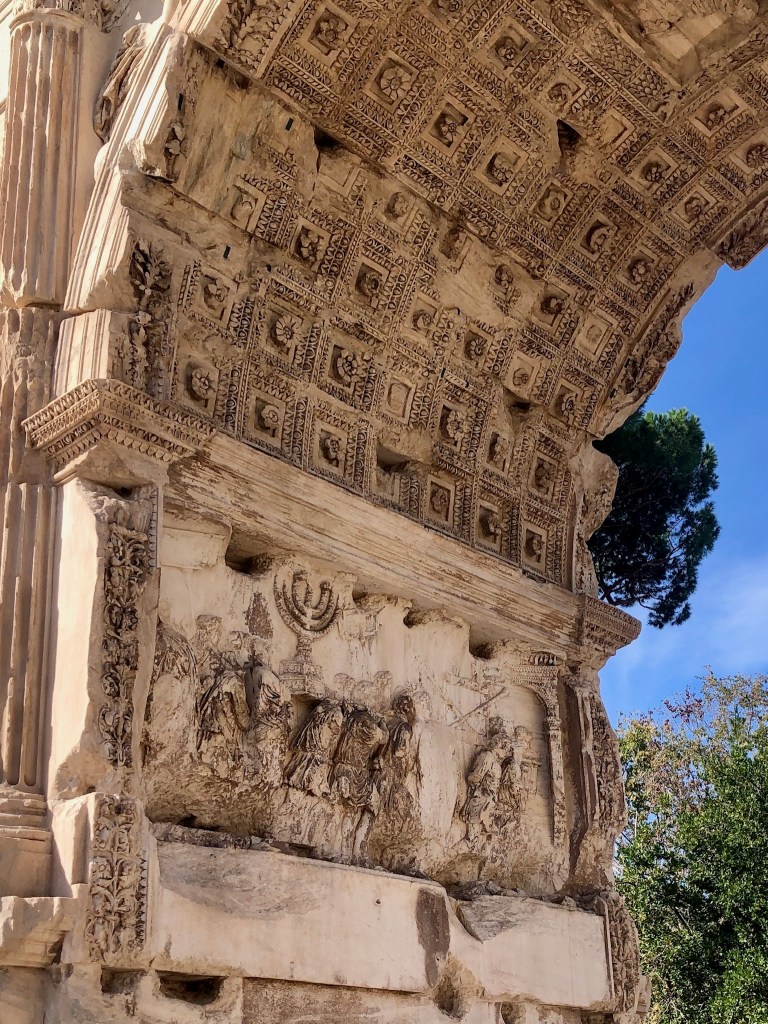
R-L: The Arch of Titus, carvings of siege and plunder of Jerusalem
There’s a lot more to glean from a tour of the Colosseum. We walked to the nearby Palatine Hill, around which the city of Rome was born; Flavian Palace, and remains of the Roman Forum. The tour was nearly three hours long and after two hot, muggy hours I suffered a little information overload; but it was a very worthwhile tour.
After lunch we hung around the area in anticipation of our evening Rome Street Food Tour, whose meeting place was the nearby Campo di Fiori. Walking over to the Trastevere neighborhood, we passed the Vittoriano built between 1885 and 1935 (yeah, it’s new) to honor the first king of the unified Italy. We took a selfie. Trastevere, translated as “across the (Tiber)Tevere” River, is an area recommended to visit if you want a glimpse of the real city because it’s where real Romans live and not full of tourist traps. We passed the river via Isola Tiberina, interested to see if this island was anything like Ile de la Cité in Paris. Not nearly as charming, nor was the Tiber as charming as la Seine.
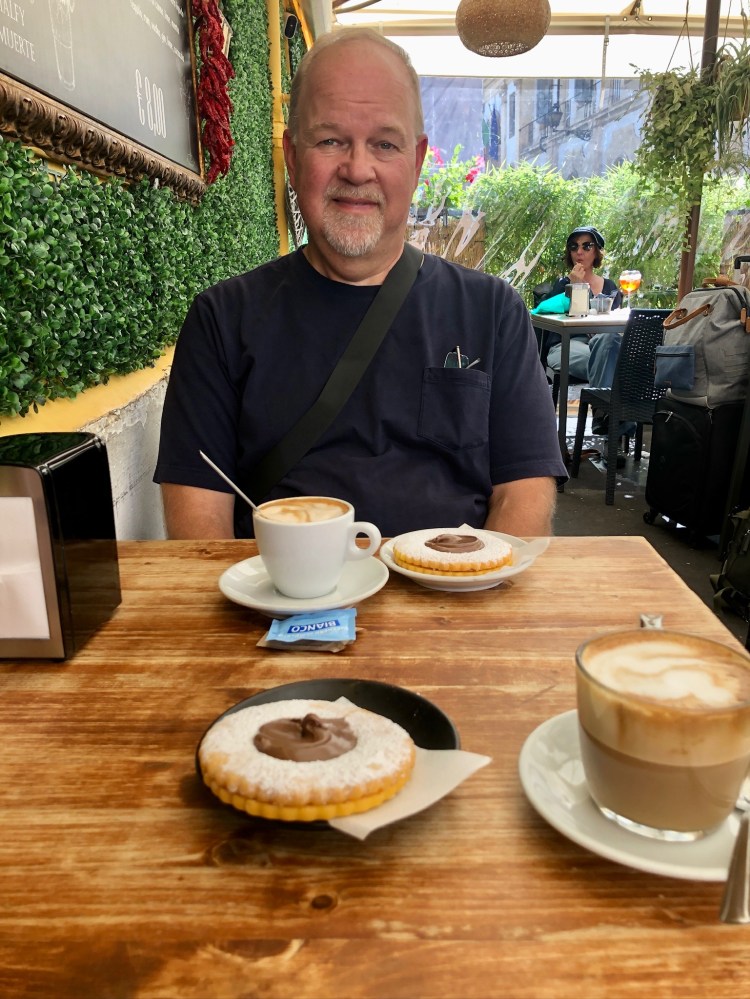
We began a tradition in Trastevere that we extended across our trip: afternoon cappuccino and pastry. The cappuccino curfew (a belief that consuming milk after a meal will mess with your digestion, with which Italians are obsessed) may exist for Italians, but they will serve tourists whatever they want whenever they want it. At the Long Island Night Caffe, we encountered our first occhi di bue (bullseye) cookies and an even more important tradition of not sharing one but sharing two.
We encountered a lovely little park in the middle of bustling Rome where we sat among the fat pigeons on benches under shady trees and caught some breezes. There was also one of the many fountains that you find around Rome. It also had one of the many water spigots you find around Rome where you can take a drink or fill up your water bottle.
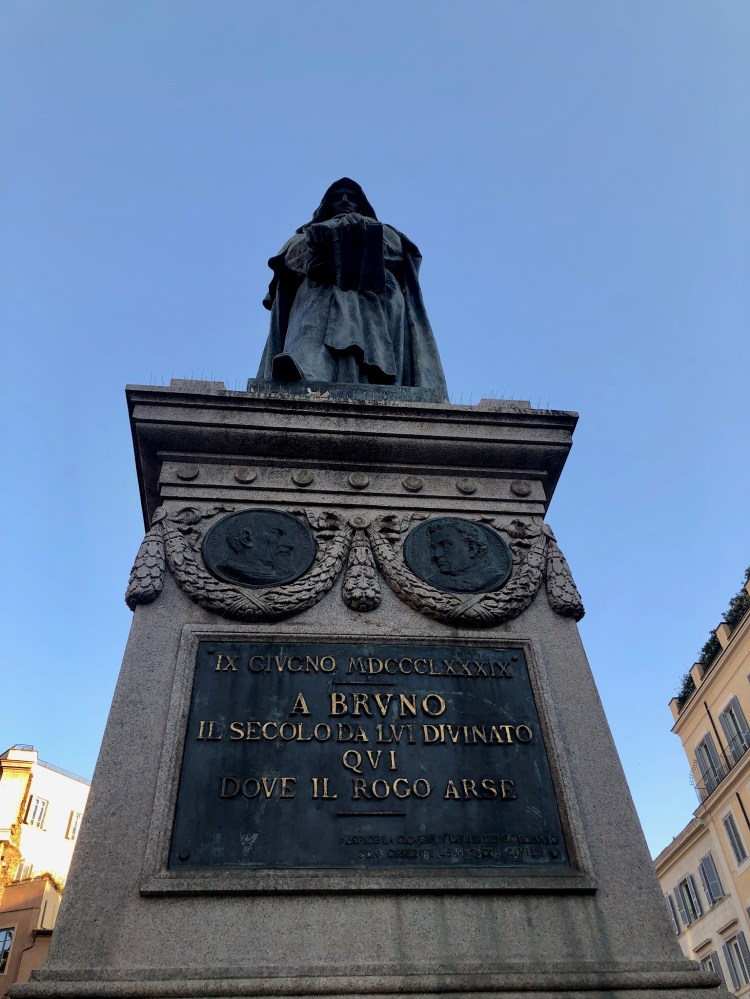
We met for our street food tour at the Fillippo Bruno statue in Campo di Fiori; it commemorates the place where the young friar was burned at the stake in 1600 for heresy. He is now seen as a martyr for free thought, and his statue and gaze loom over that end of the piazza. Campo di Fiori was my favorite piazza in Rome. It was friendly, bustling, dotted with restaurants, and located near a lot of great sites.
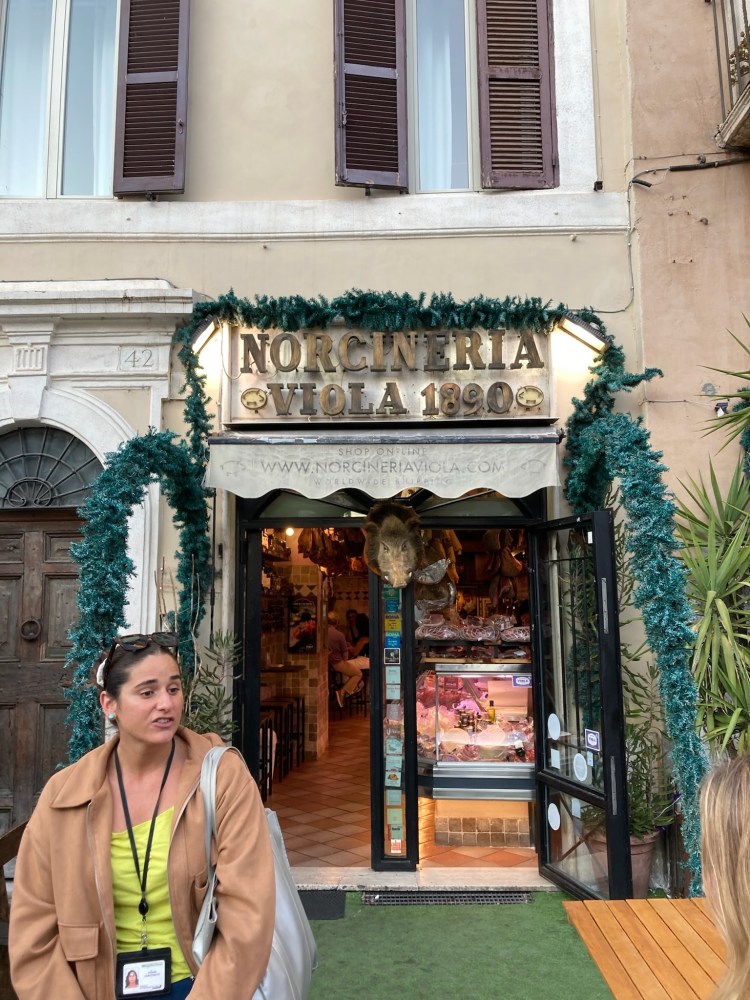
We learned about Bruno and other interesting parts of Rome on the food tour, and even learned how a proper Roman drinks the water from the city’s many water spigots. Our first stop was in the Campo di Fiori piazza at Norcineria Viola, which offered the best bites a cured, spiced pig can offer. We had various Roman salamis and wine, sold at the store.
Our next stop was called the Corner Pizza where we tried the margherita pizza and a potato and rosemary pizza. I would have never given this place a second thought because the name sounds so American. But the pizza crust was unbelievably good, like all things made with Italian flour.
The third stop was a hopping street food place where we had suppli, similar to the familiar fried rice ball arancini. Instead suppli used the creamier risotto stuffed with mozzarella and sauce, breaded and fried. Crunchy outside, creamy inside.
We ventured into the Jewish Quarter to a restaurant called Sheva, where we tried the fried artichokes famously available only in the Jewish neighborhood. It was a Friday night so it was quieter as many locals were partaking in Shabat.
Finally, we stopped at Gelateria Artigianale Corona for artisanal gelato. We only one scoop here, but it was very good. It was a long walk back to our hotel, but it was Friday night and Rome was hopping so it was fun to be in the midst. We left our hotel at 7:30 a.m. and got back at 9 p.m., a good long day!
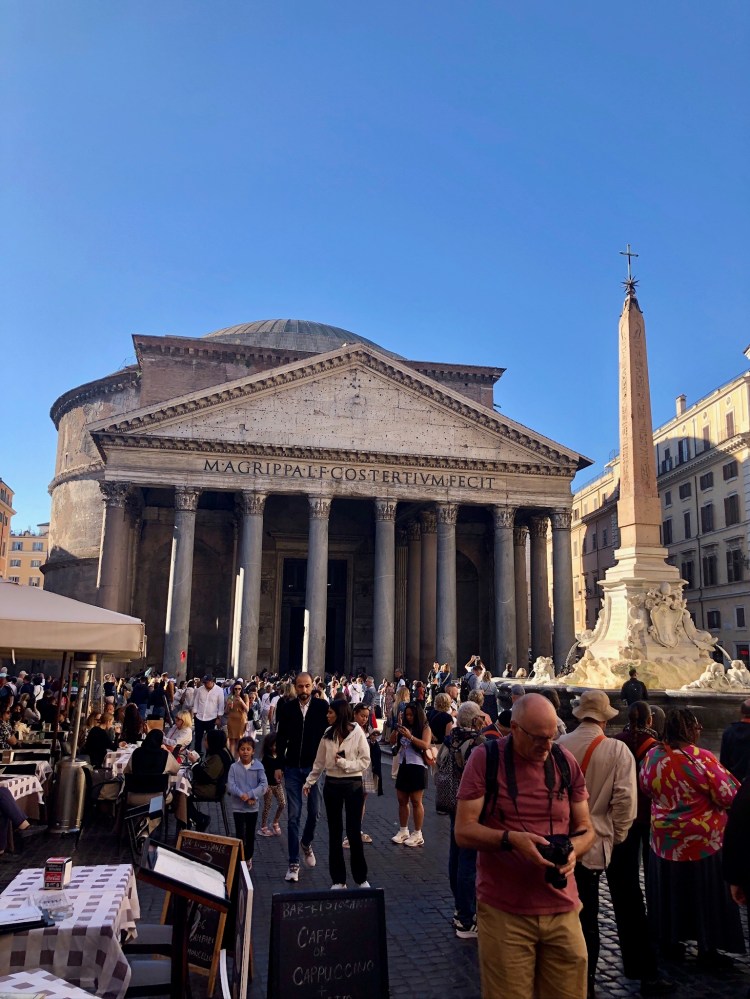
Day 3 – The third full day, and our last in Rome, was a freebie, no scheduled tours. We walked over to the Pantheon, which unlike the Colosseum was not in ruins but fully intact. It looms over the piazza and surrounding neighborhood. Originally built as a temple to Roman gods in 25 B.C., it’s been a Catholic Church since 609 A.D. when the Catholicism became the religion of the Roman state. As we toured, people were gathering for a Mass. The Pantheon has a huge dome which remains the largest unreinforced concrete dome in the world. It’s one of many buildings in Italy where you wonder “how’d they build that?”
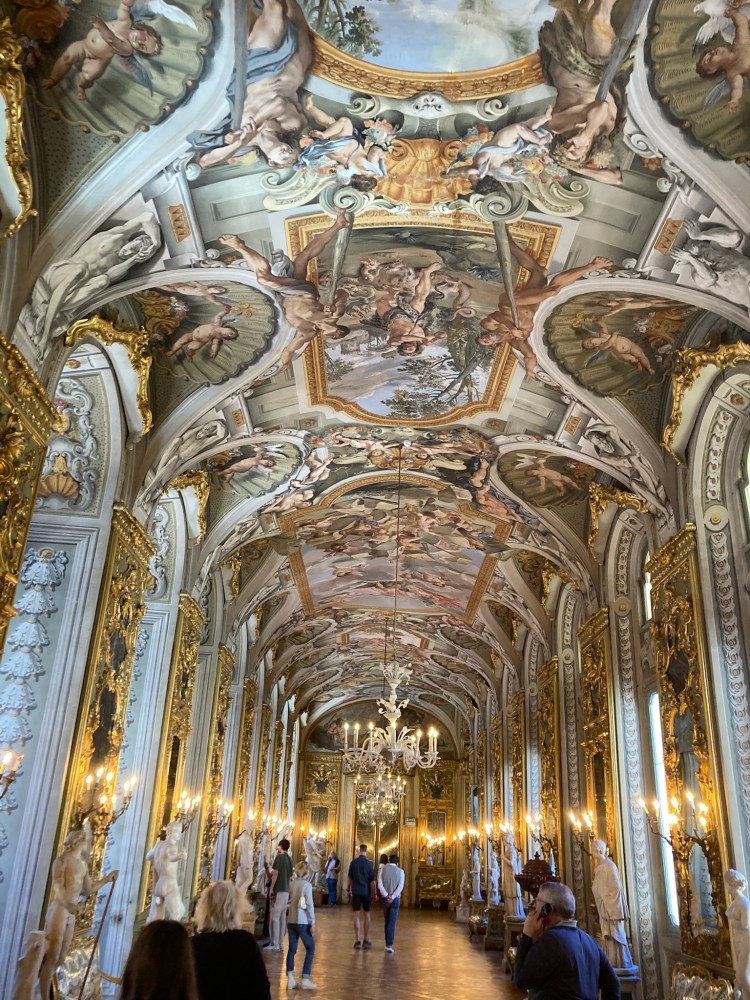
One recommendation in our pre-trip research was a visit at the Galleria Doria Pamphili, the former 17th century residence of this family. We paid for the self-guided tour and spent a little more than an hour viewing the paintings, wall and ceiling frescoes, velvet wall papers, flooring and light fixtures – all incredible works of art. We learned about the Doria Pamphili family throughout the tour, which boasts several popes and princes in its lineage. It’s a building on the busy Via de Corso that can be easily overlooked but inside holds many treasures.
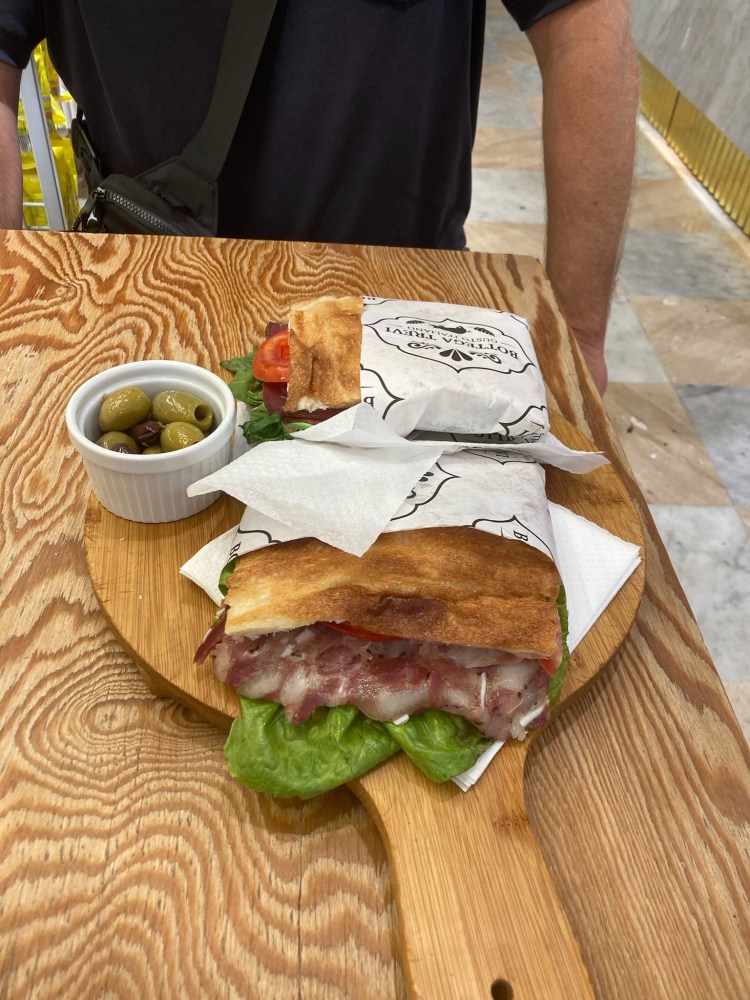
On the way back to the hotel for an hour rest, we found ourselves hungry in the heart of Rome, which has more restaurants than Catholic Churches (nearly 1000 of those). We were lured into a deli based on what our eyes feasted on from the window. We got delicious sandwiches and shared a little cup of olives. Perfect! The afternoon and evening were spent in the area of our hotel: the Borghese Gardens, Terraza di Pincio, and the Piazza di Popolo – all fun words to say. We had our afternoon constitutional at the caffe in the Gardens: cappuccinos and a pastry. We rented bikes for an hour, riding along the trails and weaving in and out of the walking and biking Italians (and tourists) enjoying the very pleasant Saturday afternoon.
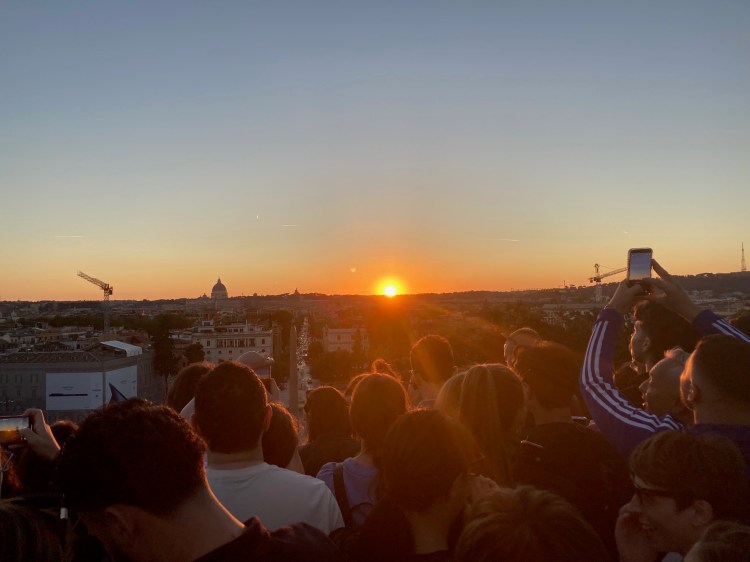
A short walk away is the Terraza Pincio from where you get the best view of the sun setting over Rome. Of course, lots of people know that and the lines start forming early. The Terraza overlooks the Piazza di Popolo and you see St. Peter’s Basilica in the background also. It’s very lovely but unless you’re first in line, you’re not getting a picture without layers of other people holding up their phones to take the picture.
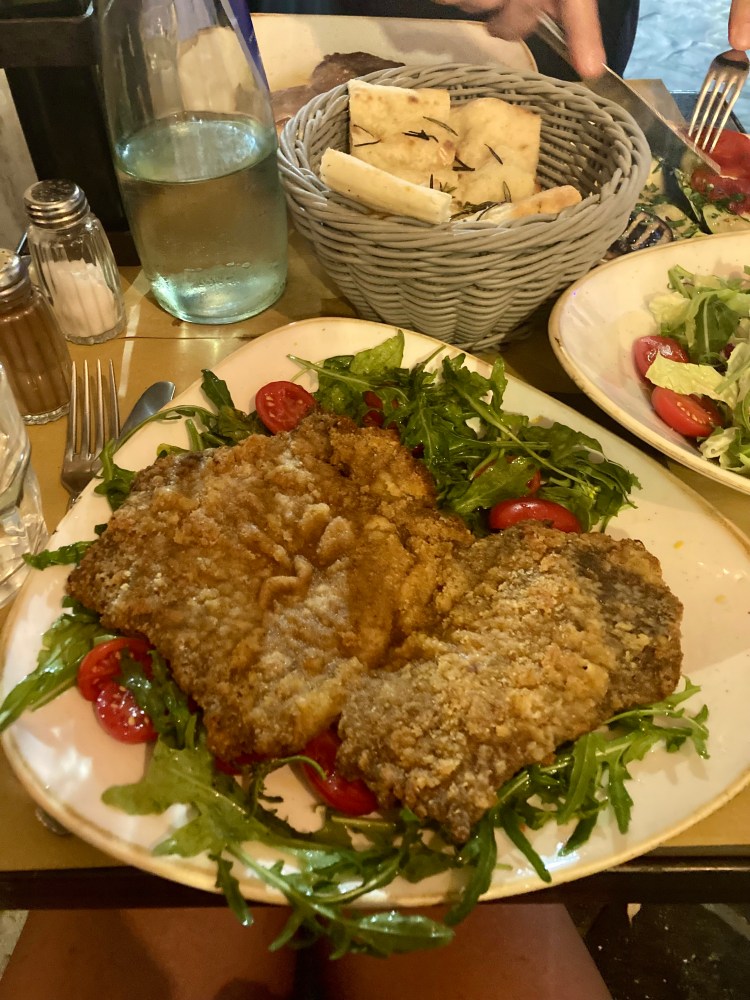
Once the sun set, we joined the crowds in walking down the stairs to get to the piazza. No piazza in Rome is complete without a statue, fountain or obelisk. There were two twin churches on the edge of the piazza as you walk back into the city. One was open so we peeked in. Again, there was amazing art and design inside. We found a restaurant nearby and sat outside and watched the crowds and the cars go by. I had incredible veal coutolettas (no wonder my grandma said cutlets with an extra syllable). We were near the Spanish Steps and walked through that piazza, which was crowded. We had to experience Il Come Latte gelato one more time so that was our final stop of the night.
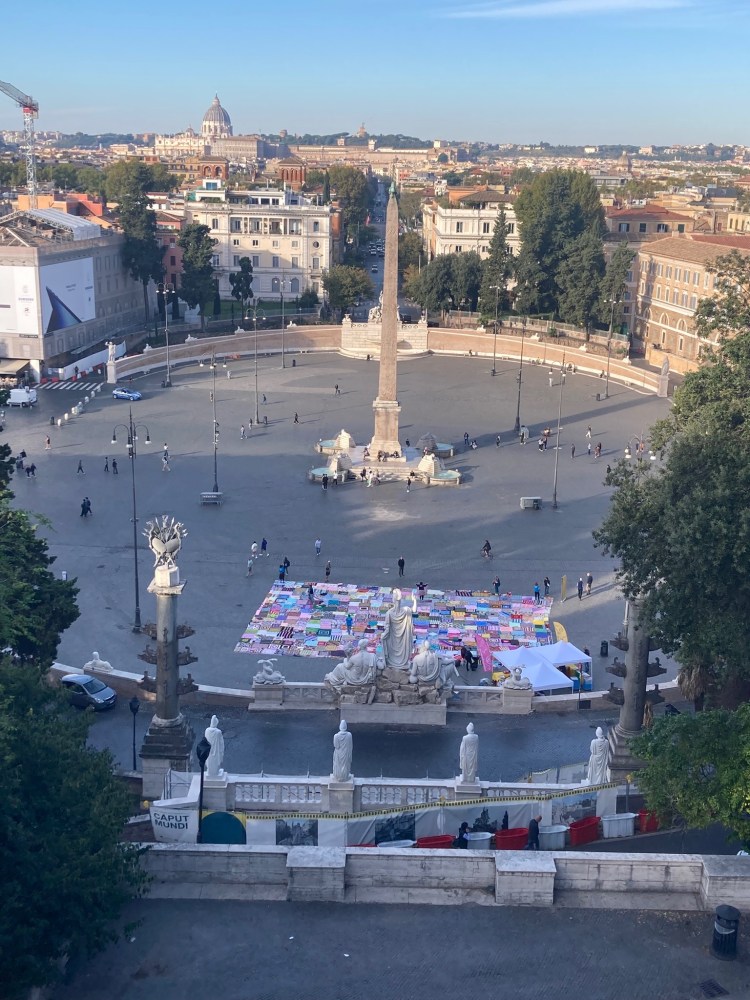
Day 4 – On fourth day we walked through Borghese Gardens and the Terraza di Pincio as well as the Piazza di Popolo again in daylight. We checked out of our hotel and took the Metro from the Spanish Steps to Roma Termini. From there we got our Trenitalia train to La Spezia, the biggest city in the Cinque Terre area. It was a three-plus hour train ride with stops like Pisa and Genoa. In La Spezia we caught the local train to Cinque Terre, the last stop ours, Monterosso al Mare.
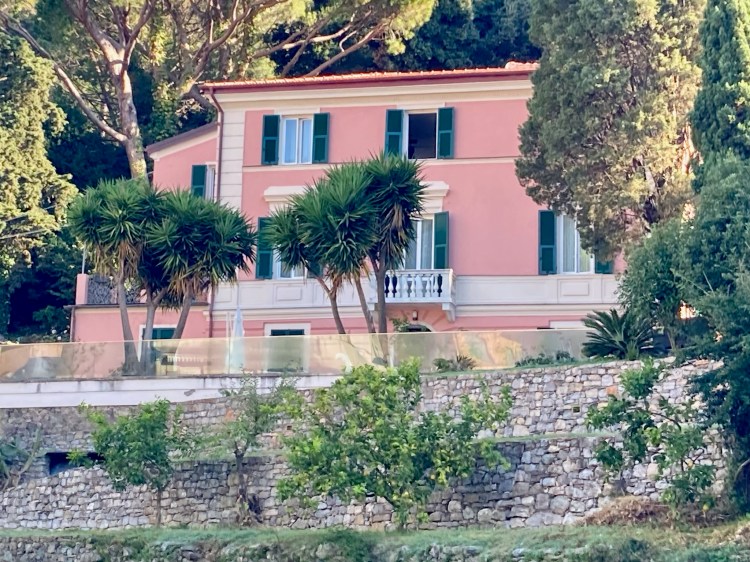
Our hotel, the Villa Accini, was a short walk from the station but again not easy to find because of the signage. It’s an old pink villa from hundreds of years ago that was subdivided into guest rooms. It was dark when we set out again, but we needed dinner. We found a place nearby called La Barbassa, whose owner was a colorful local character, with outdoor seating that was also close to the beach. It was easy to get on the promenade and check out Monterosso by night and find some gelato (not difficult in Italy).
Day 5 – On this day’s agenda was to see the five towns (cinque terre means five lands) by ferry. We bought a one-day ferry pass. Since we were at the north end, we took the ferry all the way to the southernmost town called Riomaggiore. We had roughly an hour and a half at each town before the next ferry came.
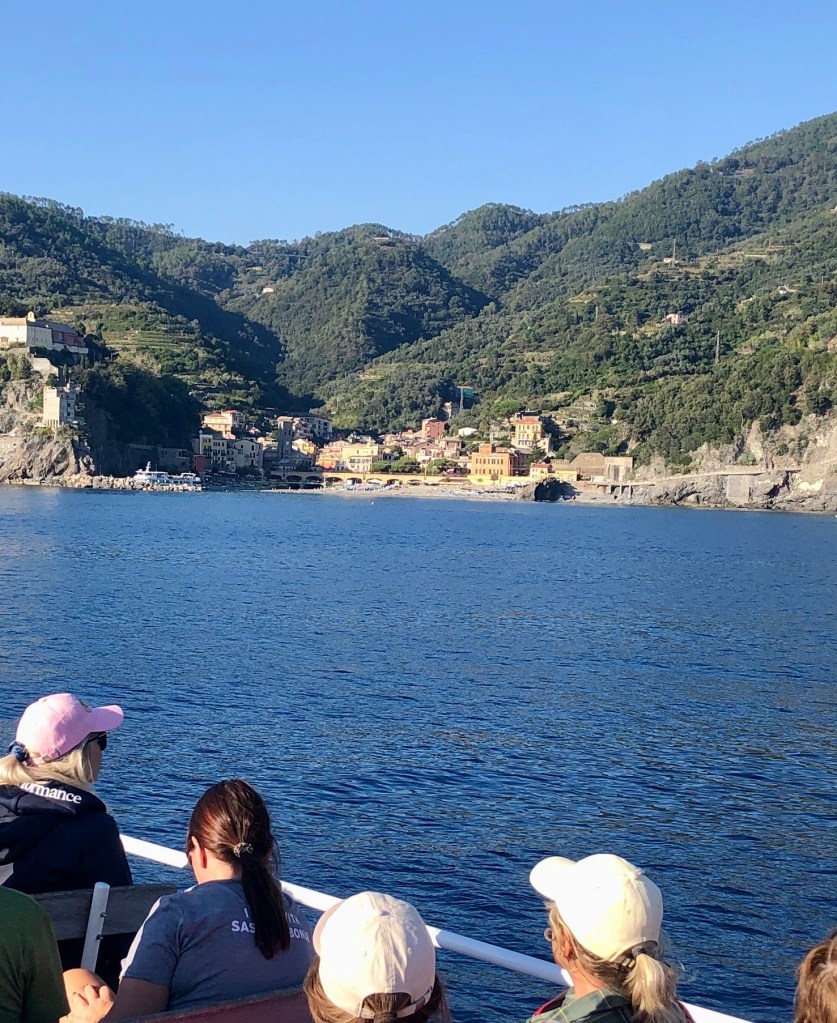
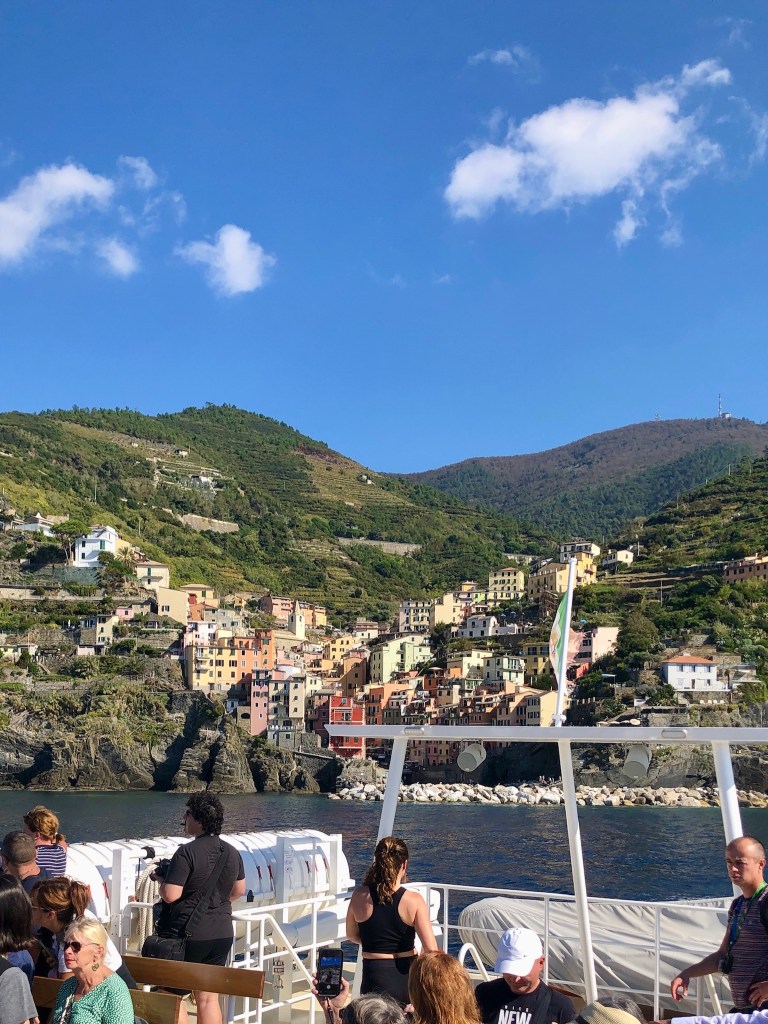
Cinque Ferry from Monterosso to Riomaggiore with stops in between
After Riomaggiore, we went to Manorola, situated primarily uphill. We did a lot of walking uphill but rewarded ourselves with a sandwich and cannoli. The middle town is called Corniglia, but it doesn’t have a port so it’s only accessible by the train and walking path. After Manorola we went to Vernazza. This city has an ancient 11th century castle that remains at the top of the hill. We took a break at a caffe here and met our first Italian server with a bad attitude.
Back in Monterosso by 5:15, we got our books and flip flops and headed to the beach. Not thinking to bring suits to a seaside town in mid-October, we waded in the Mediterranean Ocean because it was so unseasonable warm. Dinner was at Lapo’s Garden Ristorante; a charming place tucked in a garden between two buildings with a great view of the sea. We both got fish dishes but shared a plate of gnocchi with red cabbage cream sauce, walnut and sausage. We were observed cleaning our plates with bread, scooping up the sauce with focaccia. The waitress said Italians call that scarpetta; it has been described as the indescribable joy of sopping up sauce. It comes from the Italian word scarpe or shoe. Our waitress thinks it had to do with the heels of both bread and shoe scraping against a surface.
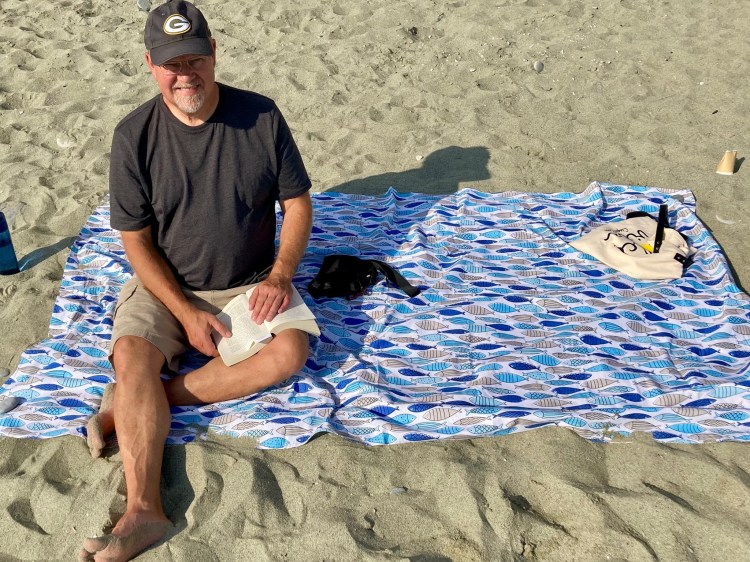
The weather was unseasonably warm with temps in the low to mid 80s. Not having swimming suits wasn’t going to stop us from going to the beach. We never met a beach we didn’t like. We even used the table cloth we bought at Vernazza market as a beach blanket.
These towns are unique in the sameness. Features like the ports and size and the views may vary from town to town. But they all are filled with pastel-colored buildings that look like they tumbled out of the surrounding hills. The towns are charming and beautiful. Monterosso was different because it was spread out more horizontally than vertically. There are nice-sized beaches in Monterosso too. Corniglia doesn’t have a port, but from the ferry it looks like the others. Focaccia dates back to the 14th century, invented in the province of Liguria, and Cinque Terre claims it as their creation.
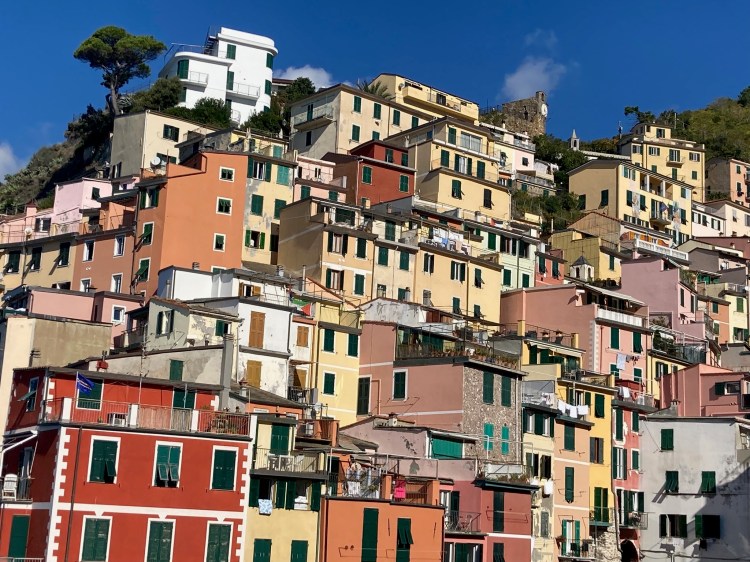
from the hills
Day 6 – Having used the ferry to get the lay of the land, we wanted to try the Sentiero Azzuro (blue trail), the walking trail between the five chinks (as my husband called the towns). Since the trail is a national park, we bought tickets to walk from Monterosso to Vernazza at the train station at 7,50 euros each. It’s a 3.5 kilometer walk between them, much of uphill on stairs-in-name-only. Naively we thought we’d take the path back. We didn’t realize that it was rated the most difficult section of the trail. My heart rate stayed at 150 for much of the time. The trails wound among terraced grape vineyards and lemon groves with the shining blue Mediterranean Sea in the background.
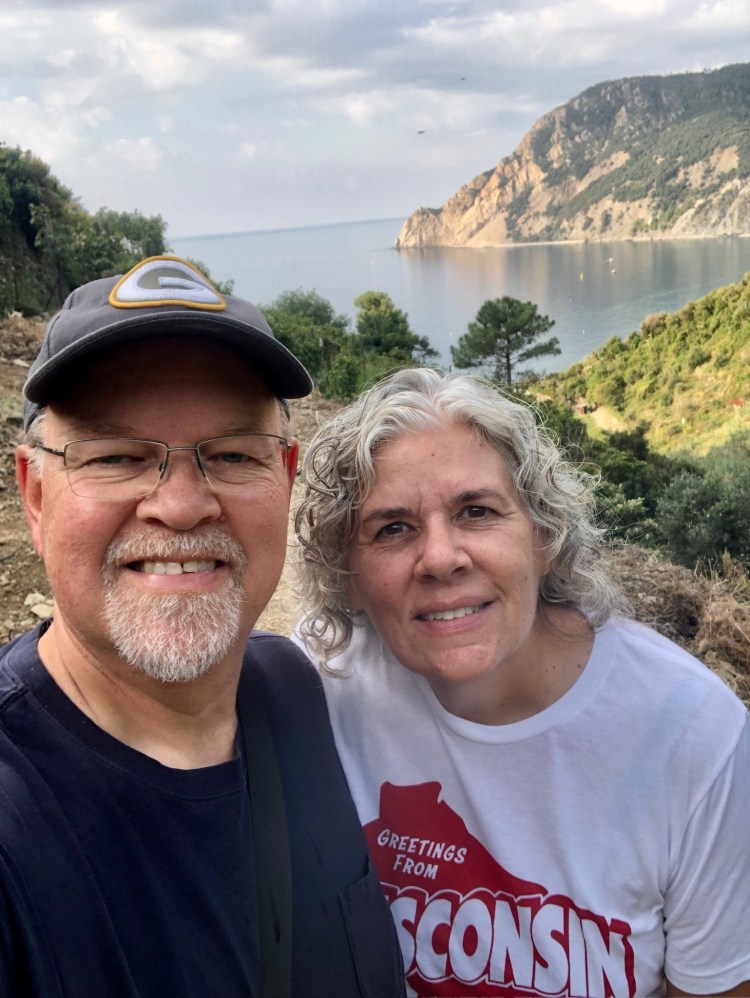
It took us nearly two hours to get to Vernazza; we were careful descending not wanting to twist an ankle or knee figuring this would not be a good place to need medical care. We stopped at a deli called Viscount and split a mortadella focaccia sandwich and pesto lasagna.
We took the train back to Monterosso and headed to the beach. We read and waded in the ocean and watched people change from bathing suits to clothes (despite the signs prohibiting this), discovering with our own eyes that Europeans really aren’t shy about their nakedness. Dinner was at a pasteria we discovered on the previous night’s walk into the south section of Monterosso. (We were staying north of the city center.) I had pansotti (an herb-filled ravioli) with a walnut cream sauce and my husband had ravioli Bolognese. Looking for gelato, we discovered a shop that had jars of tiramisu in the window. Our search was over. They were delicious.
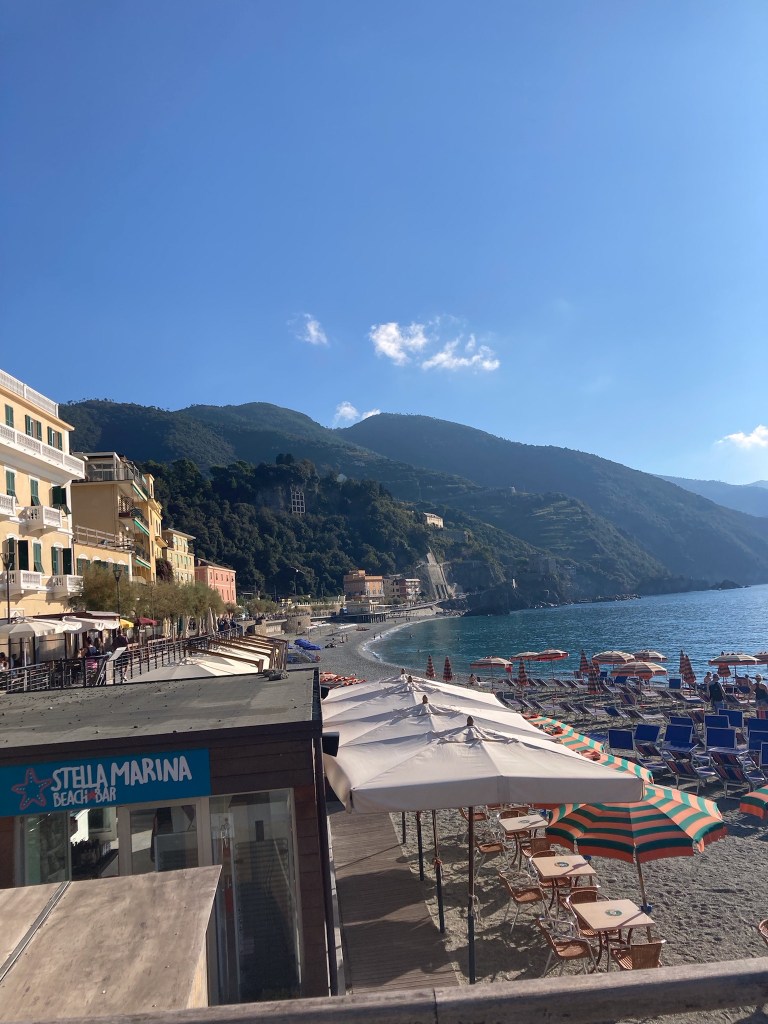
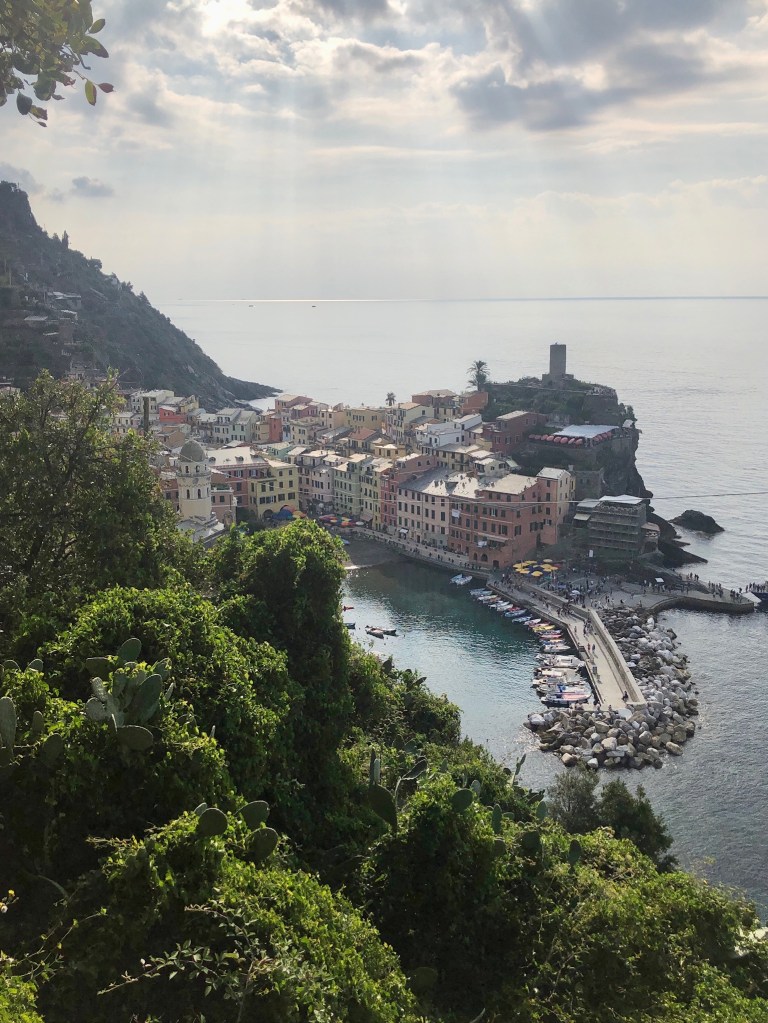
L-R: Beachside in Monterosso, descending into Vernazza from Blue Trail
Day 7 – On our final morning in Monterosso, we took a walk the south part of town, which we’d only seen in the evenings. We stopped at a focacceria to buy a few sandwiches because we’d be on a train from 12:30 to 3 p.m., and you don’t want to be hungry in Italy. I think it’s illegal. It was our travel day to Florence. We took the local train back to La Spezia, then on to Florence.
Cinque Terre was such a relaxing, lovely interlude between hectic Rome and busy Florence, a charming haven between two bustling urban centers.
We walked roughly a mile to our hotel near the Santa Croce piazza. We found the hotel easily enough but had a hard time checking in because the concierge desk was hidden in plain sight. Again, this building was repurposed —from most likely apartments to a hotel—so the flow was stilted. This boutique hotel was a luxury hotel in our eyes: the furnishings throughout were artistic and there were lots of amenities in the room, my favorite being the large tub with water jets. Like all our other hotels in Europe, the bathroom had two toilets, regular and bidet, and in this case they were square.
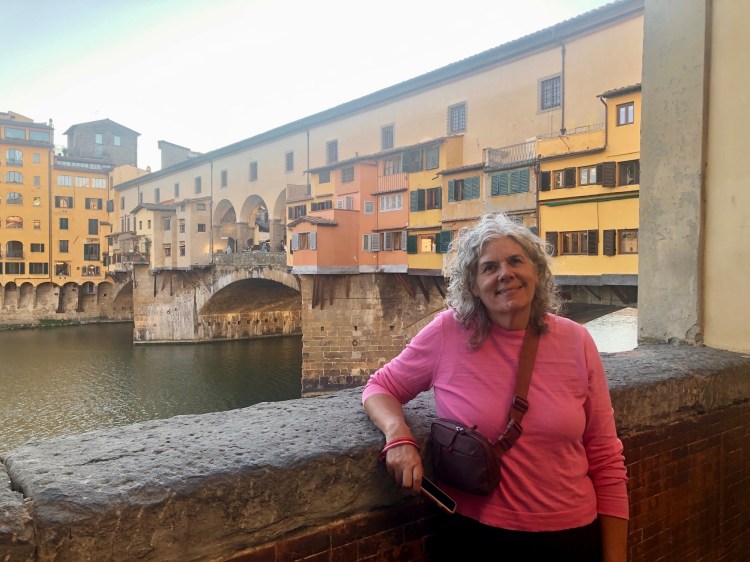
By the time we got checked in it was cappuccino time and we took that opportunity to enjoy our treats on benches around Piazza Santa Croce. We meandered to the famous Ponte Vecchio. We walked across the Arno to the Oltroarno (translated as “beyond the Arno”). Like the Trastevere in Rome or the left bank in Paris, it is an area outside the city center with lots of gems. We walked toward the Piazza di Pitti, the gateway to the Boboli Gardens.

In the shadow of the piazza we stopped at Trattoria di Pitti and shared a pizza and Caesar salad and then got gelato at Cortese Club, a vegan, gluten-free, organic gelateria. It was really good, not creamy but the flavors were bright. We walked back toward the hotel in the heart of Florence. We were in awe of the buildings, statues and public art. Back at our luxury hotel, we were kept awake on this Wednesday night by all the late-night partiers.
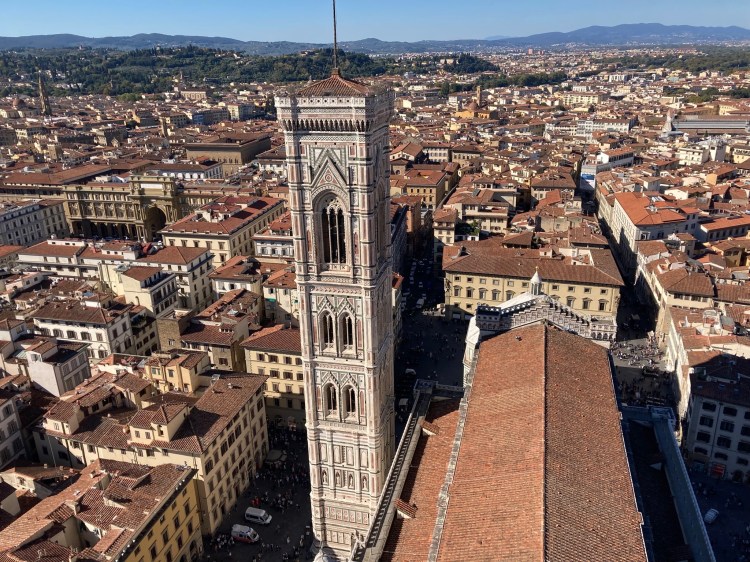
from top of il Duomo
Day 8– We were on our own for breakfast because the hotel’s buffet was too pricey at 20 Euro each. We had an 11:15 appointment to climb the top of the il Duomo Cupola. We found Café Condotta, which had a variety of offerings. We split a toasted salami focaccia and almond raisin bun, and one cappuccino each. The climb was booked ahead from the Santa Maria di Fiori (which is the formal name for the church) website. We bought the Brunelleschi Pass which allowed us to climb 463 steps to the top of the dome but also gave access to the Baptistery, Giotto’s Bell Tower, Brunelleschi’s Dome, and the Opera del Duomo Museum. The nice thing about this Pass is the sites can be visited within three days of starting. The climb, however, had a specific time that was booked and was on the first day of the Pass.
Prior to the climb we visited the Baptistry which was under renovations in large parts. The cathedral was also under renovations with scaffolding around parts of the outside. It didn’t diminish the views and was very understandable that with all this priceless, ancient construction we’d see ongoing renovations. I’m surprised we didn’t see more renovations throughout ancient Italy.
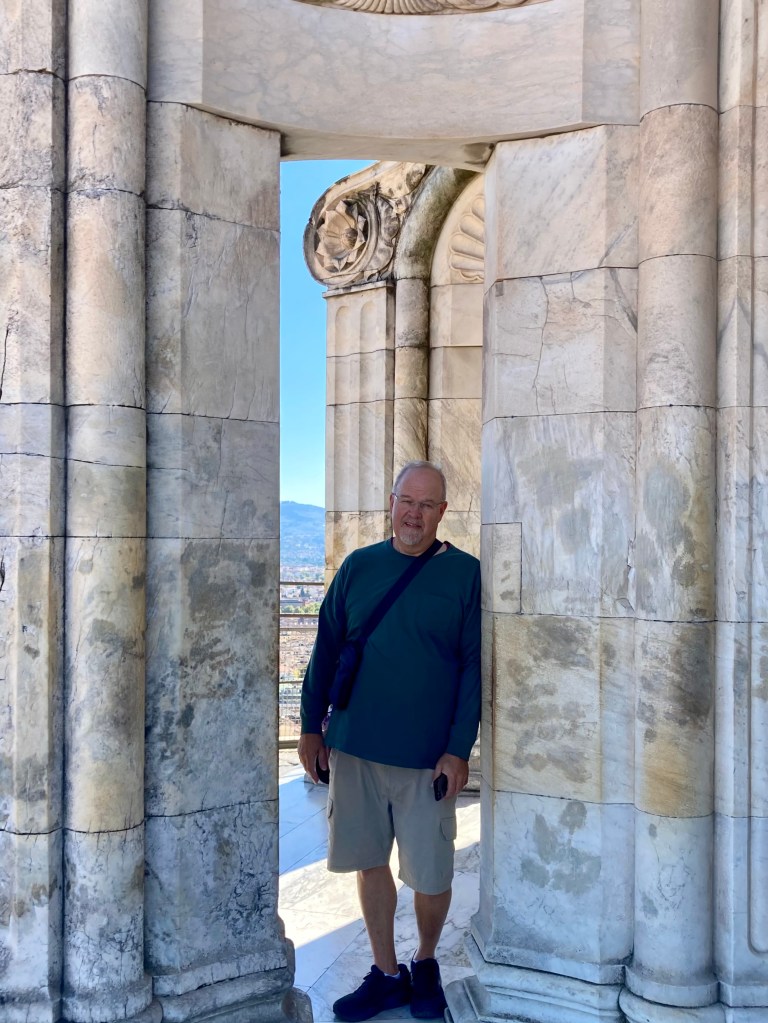
The climb to the top of the Duomo was narrow but not nearly as exerting as our Blue Trail climb in Cinque Terre. My heart rate only got to 105. It took 45 minutes to climb up and down and take in the beautiful panorama of Florence and the Tuscan mountains in the background. And to take a few selfies, of course.
We followed the climb with a self-guided tour of the Opera del Duomo Museum. It contains the original statues and artifacts removed when the Medicis updated the cathedral to Renaissance art. The cathedral project began in 1296 and the art was primarily medieval classic antiquity. The Medicis were patrons of the new art. Renaissance is a 19th century term to describe the period, whose birthplace was Florence, from the 14th to 17th centuries. That happens to coincide with the Medici family’s rule over the city-state Florence. It’s hard to visit anything in Florence without hearing the name Medici.
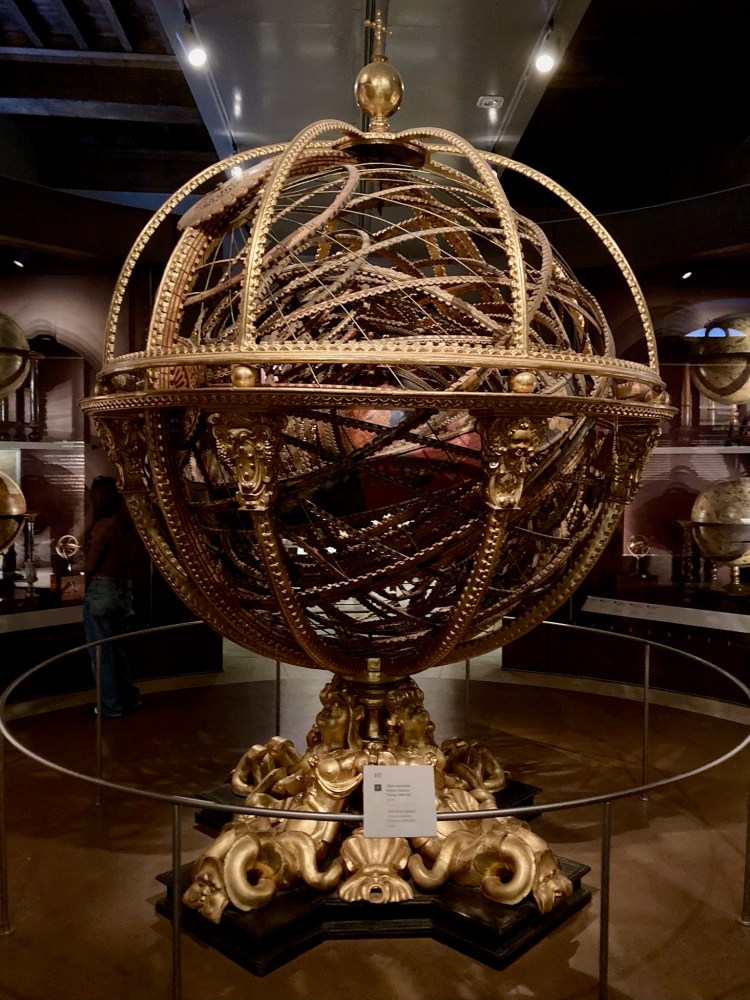
Galileo Museum
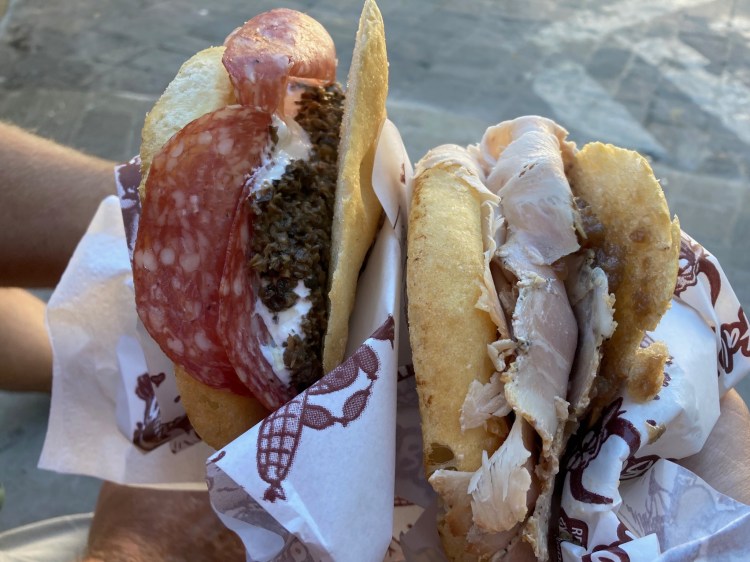
Here and now is when we discovered the perfect sandwich. Walking down a narrow lane, we noticed local construction workers leaning outside a doorway eating the most beautiful-looking things. We investigated the place, Il Buffalo Trippone, and pinned it as a must-do. The small space offered nine sandwiches and no place to eat them. Luckily around the corner of any place in Florence you’ll find a piazza or steps of an ancient building. For us we devoured those beauties the steps of the Museum of Leonardo Di Vinci, whose art defined the Renaissance and Florence. Yes, I keep using the word beautiful. Stunning, gorgeous and striking would work too. You eat with your eyes first and the eyes weren’t hyping us. These sandwiches were that good!
We spent our afternoon touring the Galileo Museum near the Arno River. It was less about the story of Galileo and more about the spirit of those scientific innovations that, largely funded by the Medicis, spilled out of Florence in the Renaissance era. It’s mostly scientific instruments, crude at first but becoming refined, and important in the advancement of discovery and understanding of the physical world. It’s not just the idea of these precise measuring instruments but the craftsmanship of designing and building them. It was really worthwhile; and less hectic that other museums in Florence.
This afternoon’s aperitivo had a twist. We returned to Café Condotta for ochi di bue and cappuccinos. Waiting outside the café, a woman walked by and stopped and looked at me. We pointed at each other, in that way you do when you know you know someone but can’t remember from where. It turns out we share a common friend named Beth. All of us still live in our hometown. Karen went to school with Beth, and I know Beth from our daughters’ friendship. We chatted about what brought us to that place at that time, then took a selfie to send to Beth. Small world.
After walking over the Arno, window shopping and seeing sights, we decided to have an evening to splurge on the famous Tuscan steaks. Since it was a once-in-a-lifetime meal, we ordered the pecorino pasta too.
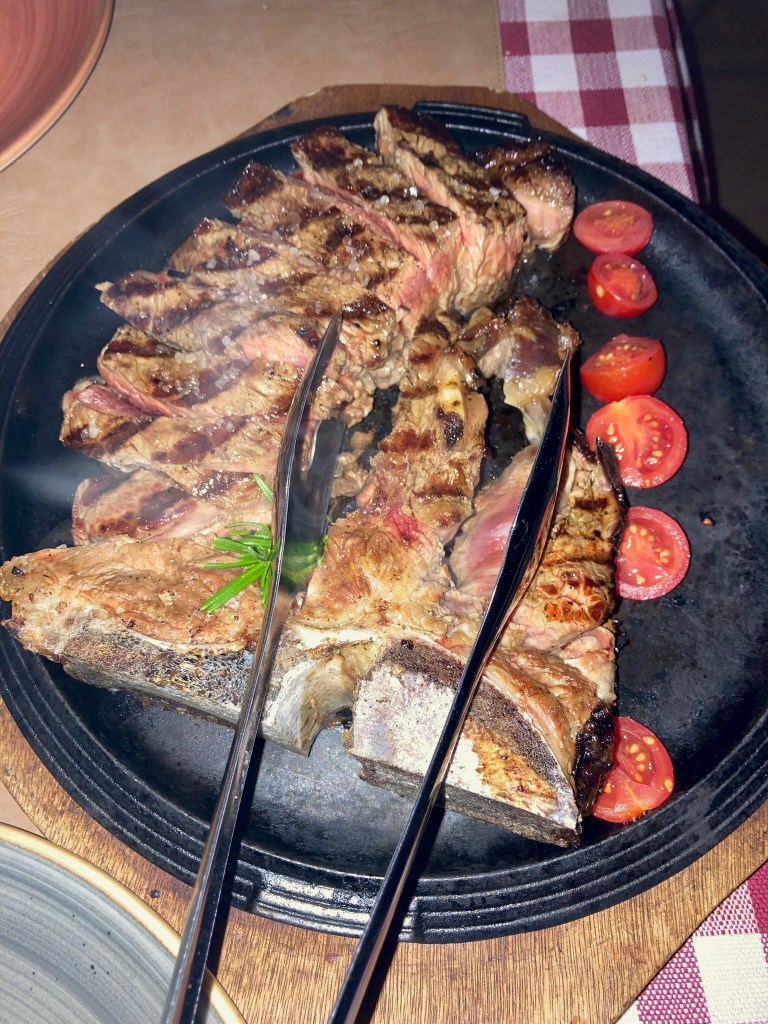
Our steak was a 1.3-kilogram T-bone done medium, which was the highest doneness we could get. While that was prepared, we enjoyed the pecorino pasta show (like tableside guacamole at a Mexican restaurant but with fire and cheese).
The pecorino rind comes to the table on a cart with al dente pasta. The preparer tossed a shot of vodka in the pecorino rind to start the flambé. Because there are active flames, he then carefully scraps melted cheese from the sides of the rind. When there is enough melted cheese and the flame has extinguished, the pasta goes in to get tossed in the pecorino. The final step is plating, shaving truffle over the pasta, and setting on the table. Seconds later the steak made itself known, sizzling on a cast iron plate. The restaurant’s work is done; the rest is up to the eaters. We ate just about everything, knowing we would never have anything like it again. The night’s capstone was gelato (you only live once), only after a long walk and only one scoop. The end of this long day required a nice long soak in the luxury jet tub in our luxury Florence hotel bathroom.
Day 9– It was our final day in Florence and our final day in Italy and we wanted to cross some things off our to-do list. It was a big, open day and our oldest daughter’s birthday!
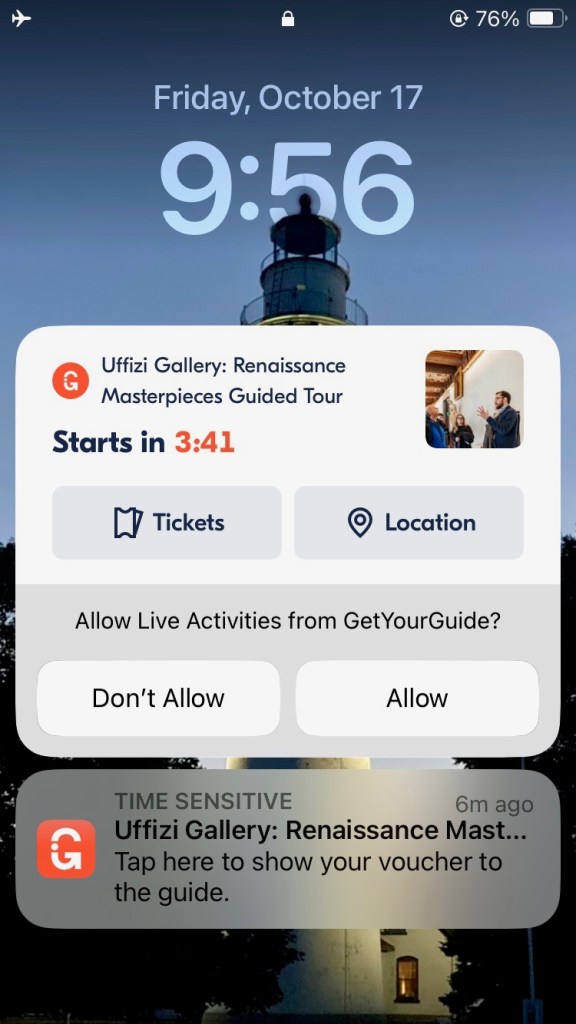
It was sunny and bright but temps only reached the high 60s; it was nearly perfect. We skipped breakfast because of the previous night’s big, late meal, but we didn’t skip cappuccinos. We went to our 10 a.m. scheduled tour of the Uffizi Gallery through Get Your Guide. Our guide Rachel was an early fifties college instructor who specializes in Michelangelo. Uffizi is Italian for office, proving Italians say everything better. Based on its location, Florence, and its beauty, you may have already concluded the Uffizi was built by the Medicis. It held the offices for their empire.
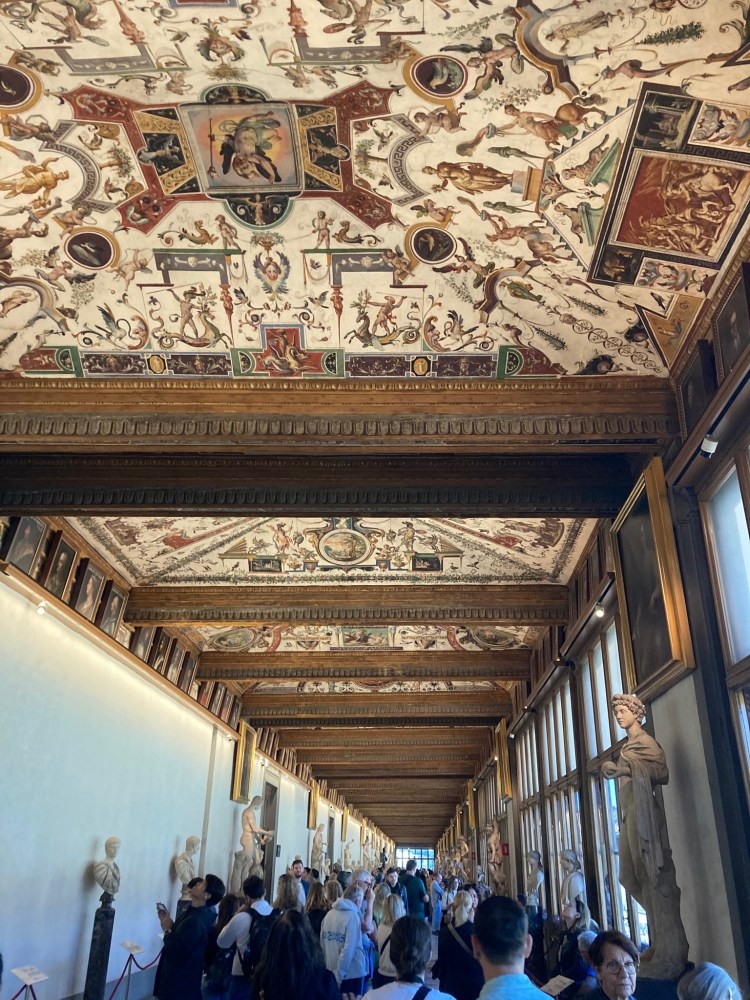
Renaissance Florence
Room by room, Rachel compared Medieval art to Renaissance art so we could see hundreds of years of change before our eyes. She explained the Medicis and their reign of the city-state. Important to the family was the Vasari Corridor, built in the 1560s, an elevated corridor that connects the offices to the Palazzo Pitti (Pitti Palace), that goes across the Arno via the Ponte Vecchio. Why mingle with the people on the streets, especially if you are the powerful Cosimo I de Medici, whose predecessor was assassinated and who consolidated a lot of power and control? You might risk your life just to go to the office.
When the official tour was over, we were allowed to stay and enjoy the art gallery on our own. We didn’t know as much without our guide, but we did get to see the Medusa and room after room of amazing works.
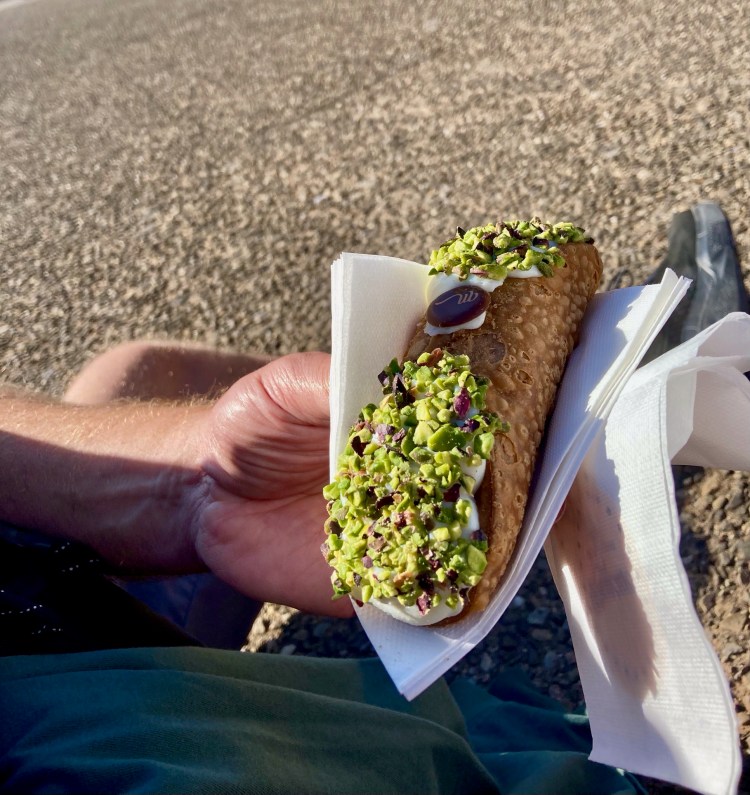
Immediately after we marched right over to Il Bufalo Trippone. We both tried different sandwiches, but we did sit on the same steps. We moseyed back to our hotel because we had to check into our flight and order our taxi for tomorrow’s drive to the airport at 3:30 a.m. We recharged our cell phone batteries and our physical ones a bit for the final push on our last afternoon in Firenze. We made sure our cappuccinos weren’t too close to dinner like the previous day. En route to Boboli Gardens, we stopped at Mancusa Gelati Italiani 1920 for fresh-filled cannoli and cappuccinos. Yeah, it’s got gelato in its name and its offerings did look good; however, we had “genuine Italian cannoli” on our to-do list, and we picked the right spot. There are a variety of sizes of unfilled cannoli shells; a variety of pastry bags with ricotta, chocolate, or pistachio fillings; and a variety of finishing dips like pistachios, chocolate and fruits. We split a large ricotta-filled, pistachio-dipped cannoli, a classic combo that was so divine in every bite that we almost split a second large one.
We needed the energy to stand in line for tickets to the Boboli Gardens. These gardens, built in the mid-16th century, became a model for many European courts; it’s considered an outdoor museum with Renaissance statues and fountains like the Fountain of Neptune. At first it was reminiscent of the gardens at Versailles. But this one has depth and height; as you go deeper you will climb higher. You’ll reach a ridge at the Knight’s Garden where you view more villas and terraced gardens and valleys. At each plateau in the gardens, you’re met with an ancient statue or fountain and stunning view of the Duomo, Bell Tower, or church.
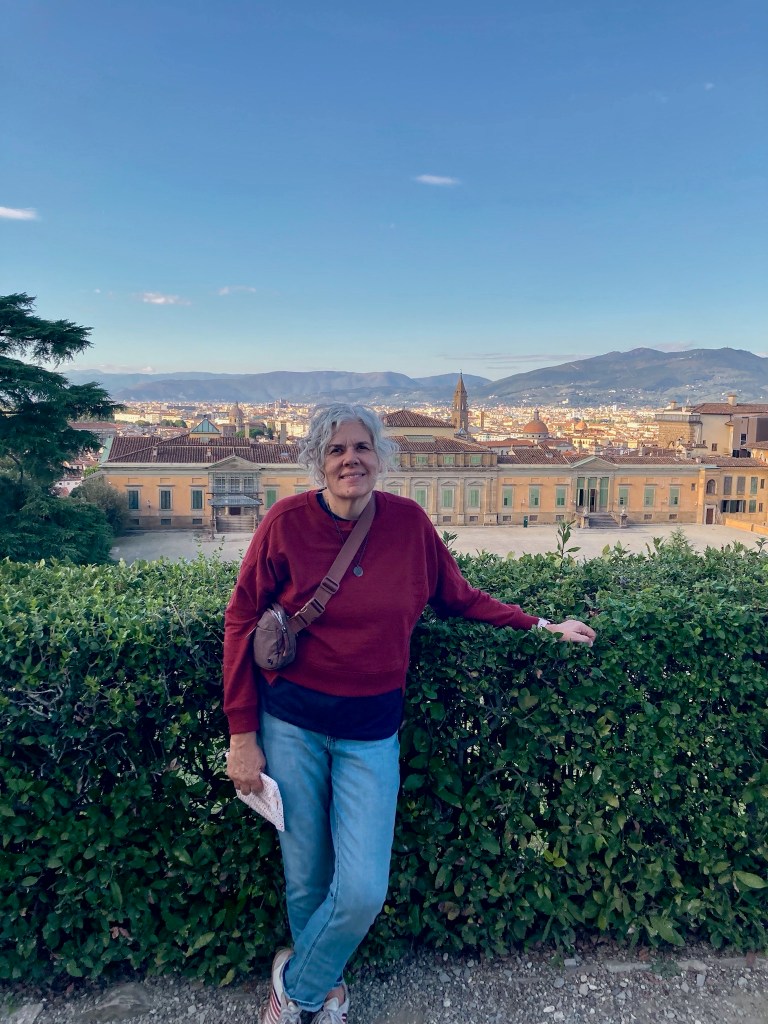
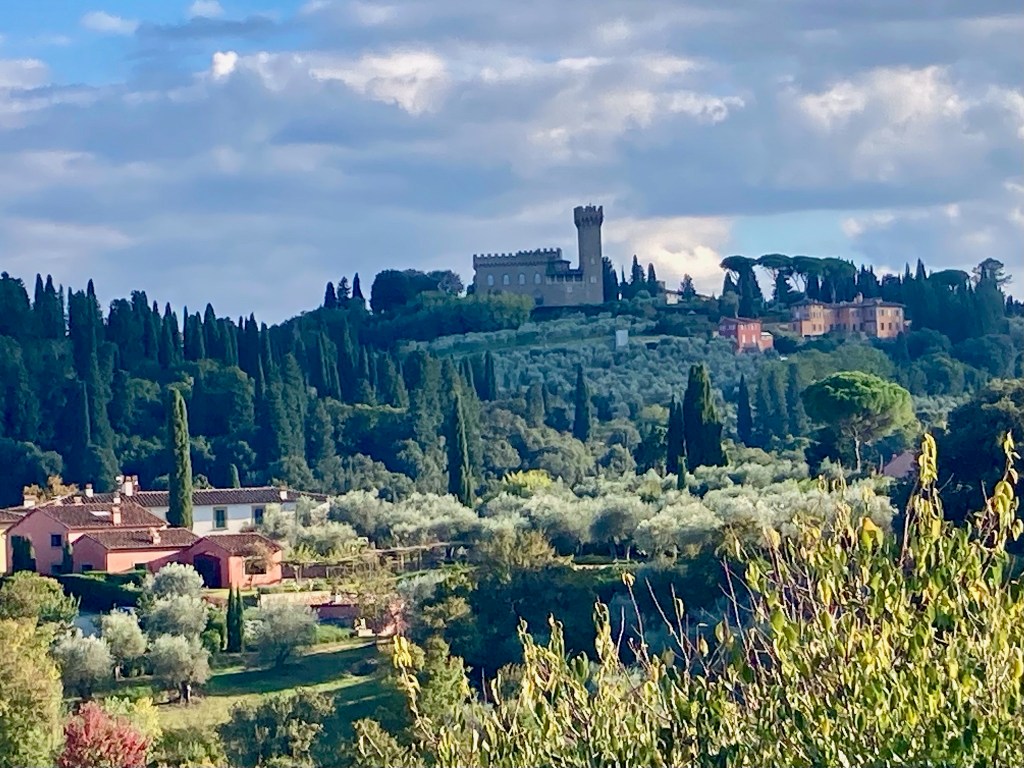
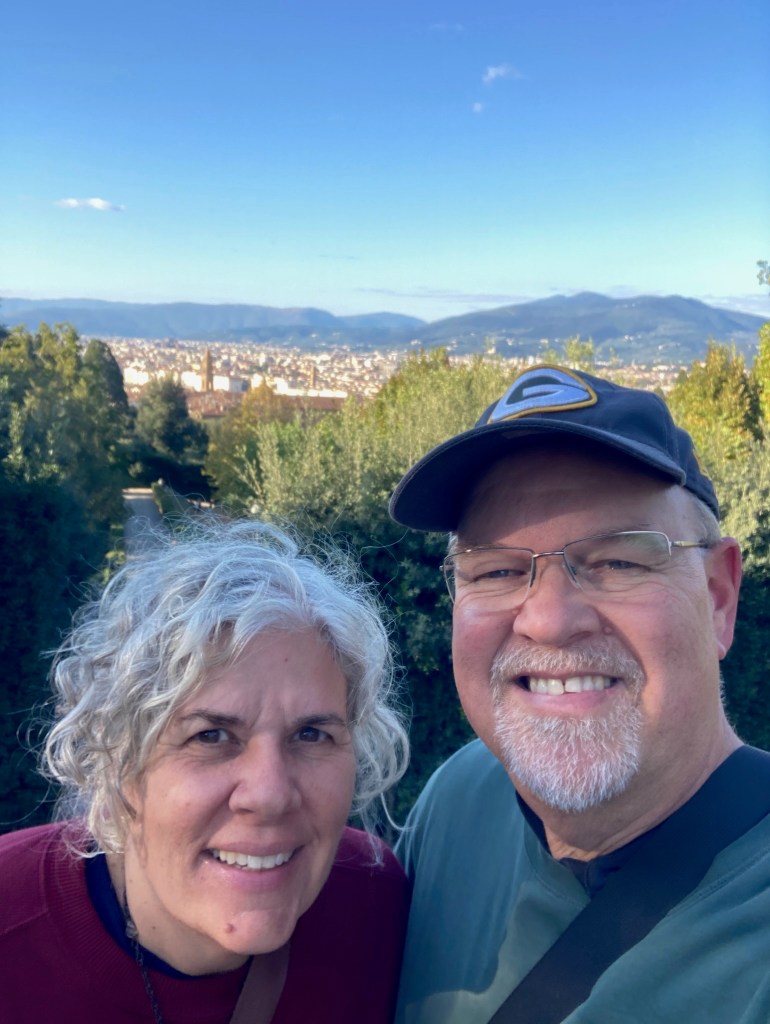
Views from several points in the Boboli Gardens
We spent several hours there. And leaving presented another opportunity to check off our list: an Aperol Spritz aperitivo. There were countless opportunities to try one in Rome, Cinque Terre, and Florence. It seems it may be illegal not to have an Aperol sign in your establishment. I drank most of it; my husband just wanted to try it. It was like a Pimm’s cup or even an old-fashioned; a light drink with bitters and fruit and sweet mixer.
By now we were hungry for dinner and, not knowing where to go, we settled on Il Bufalo Trippone again because there were sandwiches on the menu yet to try. However, the sign on the door (horrifyingly) said “out of sandwiches,” leaving us orphaned in a big city with no plan.
Never fear for a place to eat in Italy; we settled on a bustling place on the Guicchi Piazza. We shared an order of cacio e pepe (cheese and pepper), re-confirming that the Italians say everything better. It was our favorite pasta dish so far on this trip. Plus, it’s so fun to say! I had a Tuscan beef stew (called Peposo) with stewed white beans, and Leif had grilled chicken with grilled veggies. I loved my Peposo so much, I looked up a recipe and made it twice at home. https://www.insidetherustickitchen.com/peposo/
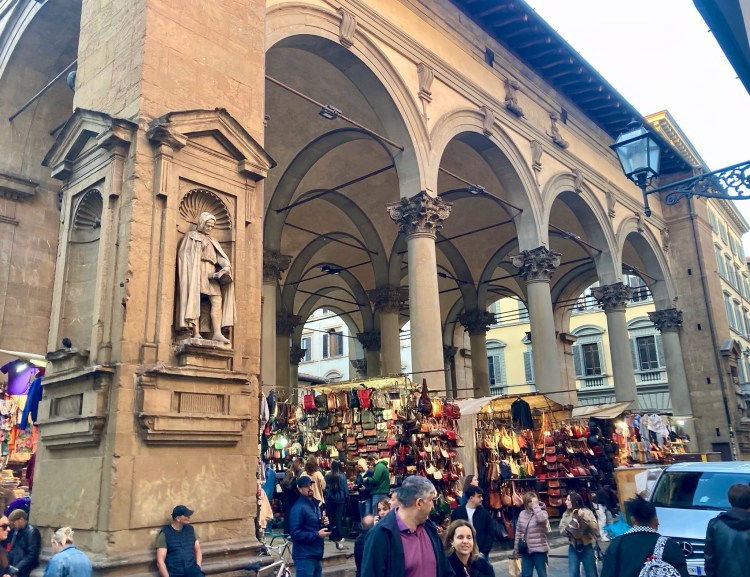
We had one last morsel to try in the form of gelato. One of the YouTubers we watched said Venchi was the best. We saw them in Rome but had our favorite there. Monterosso didn’t have chain gelato stores, but Florence had many. We found the closest one and ordered: I got a two-scoop cone with Tuscan cream and tiramisu gelato; Leif got a cup with chocolate hazelnut. We ate at the steps of the Mercado Nuovo. It was late and vendors were taking down their stalls; it’s full of leather vendors during the day. The gelato was almost as good as Il Come Latte. It was a great way to cap off the day and the trip. It was bittersweet to have to leave the next day.
I took us on a goose chase, putting St. Croce hotel in my maps apps instead of the St. Croce piazza which our hotel was nearby. The day’s 24,000 steps qualified me for another soak in the luxury jet tub in our luxury Florence hotel.
Day 9 – The airport in Florence is small and a half-hour drive from our hotel so we were forced to take a taxi. It came at 3:30 a.m., to ensure we got to the airport when it opened at 4 a.m. At 3:30 in the morning, Florence is still hoping with people celebrating “I don’t know what,” and our driver didn’t hold the convention about the half hour it takes to get to the airport. We had a harrowing ride, using gas stations as shortcuts. The “30-minute drive” took 18 minutes; we got to wait outside for 12 minutes for the airport to open and get our heart rates back to normal.
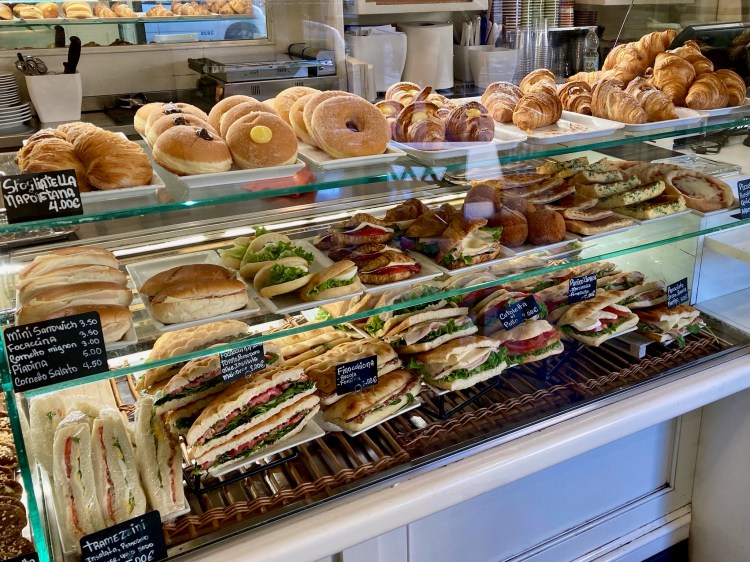
It took an hour to get to Zurich, Switzerland, where we spent the next six hours. There is much better access to healthy food in European airports. We had early morning cappuccinos at a lovely café, then explored the airport to pass the time. One popular restaurant had a section in the middle where they were making fresh soups and broths and it smelled so good. Lots of restaurants and food stands had freshly made sandwiches and you could just tell the bread was fantastic. After boarding the plane, it took 9 ½ hours to get to Chicago. Swiss Air gave us good food, and lots of it. It helped break the monotony. Getting our luggage, shuttle to our parking spot, and driving back to Wisconsin put total trip time at 22 ½ hours (from the time our taxi picked us up in Florence). If I had to do it again, I would have taken a train to Rome and flown directly to Chicago. That was a grueling day of travel.
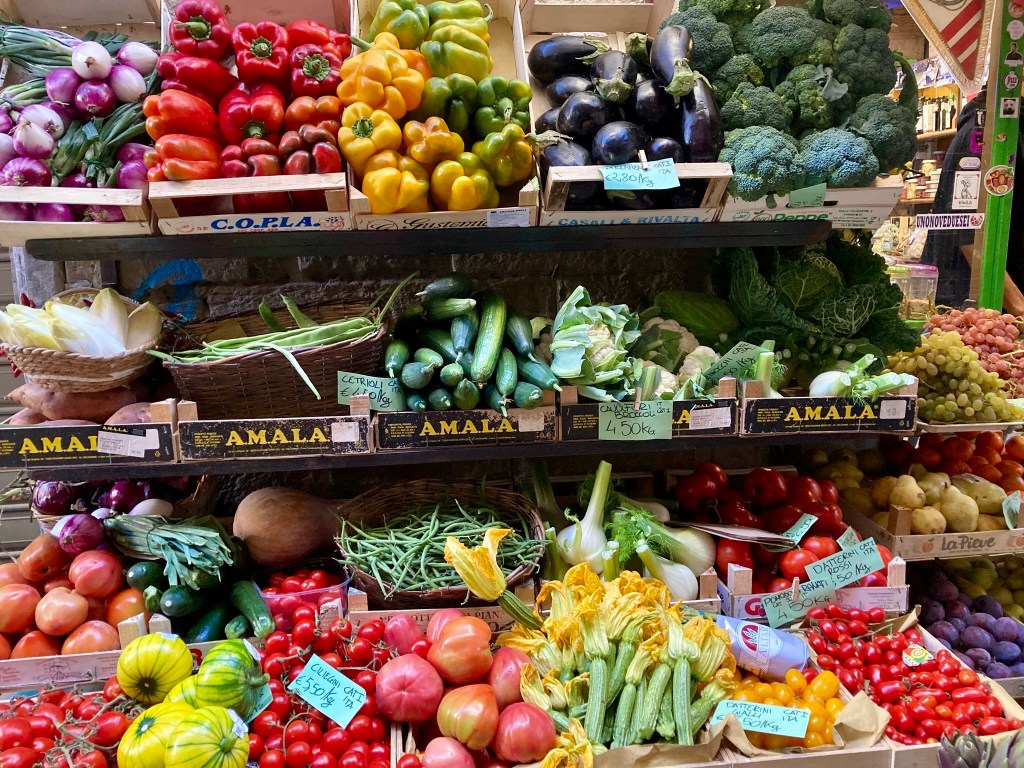
People ask what I liked best: the food. People ask which city I liked best. That ‘s tough because they all offered something incredible. I wanted to visit Florence for the Renaissance art and Cinque Terre for its beauty and the ability to be actively a part of it. Then we thought that since we were flying into Rome, we’d spend some time there. I was amazed at how much I loved Roma! It an ancient, historic city; it’s a cultural melting pot; it’s large and urban; and it’s family friendly. If you had to pin me down, I’d say the Cinque Terre was my favorite. But other two cities added so much texture and depth to the trip.
I’d do it again in a heartbeat. But other countries next!

